Songara All Ayurvedic
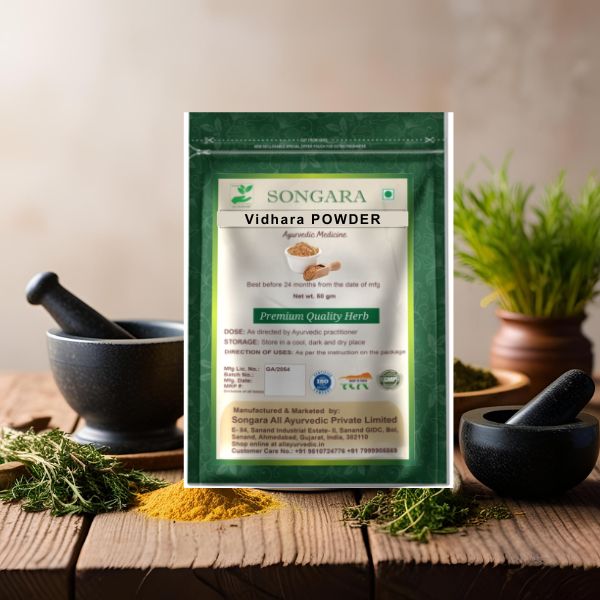
Vidhara Powder – The Ayurvedic Wonder Herb 50 g
Vidhara Powder – The Ayurvedic Wonder Herb 50 g
पिकअप उपलब्धता लोड गर्न सकिएन
🌿 Vṛddhadāru (वृद्धदारुकः)
Botanical Name: Argyreia nervosa (Burm. f.) Boj.
Synonyms: Argyreia speciosa Sweet.
Family: Convolvulaceae
English Name: Elephant Creeper
1. Synonyms (नāmāni)
Vṛddhadāru (वृद्धदारुकः), Āvegi (आवेगी), Chāgāntrī (छागान्त्री), Vṛṣyagandhikā (वृष्यगन्धिका), Antaḥkoṭarapushpī (अन्तःकोटरपुष्पी)
Etymological Meanings:
- Vṛddhadāru – “वृद्धं दारयति” – that which removes the effects of old age, i.e., rejuvenator.
- Āvegi – “आ समन्ताद् वेगो अस्त्यस्य” – spreads vigorously in all directions.
- Chāgāntrī – “छागस्य अन्त्राणि इव शाखाः अस्याः” – its stems resemble the intestines of a goat.
- Vṛṣyagandhikā – having a distinct musky or bear-like odour (vṛṣya = aphrodisiac; gandhikā = fragrance).
- Antaḥkoṭarapushpī – having bell-shaped inner flowers.
2. Regional Names
- Hindi: Samudraśokha, Ghāvapattā, Vidhārā
- Marathi: Samudraśokha
- Gujarati: Samundaraśoṣa, Varadhāro
- Bengali: Vijatāda, Viddhatādaka, Samudrapāla
- Tamil: Samudra-paccai
- Oriya: Maghilai, Indālai
- English: Elephant Creeper
3. Botanical Description
A large, woody perennial climber found throughout tropical India, especially near villages and hedges. It is also cultivated as an ornamental plant for its attractive purple flowers.
- Stem: Thick, woody, white and tomentose (covered with soft hair).
- Leaves: Large, simple, ovate with a cordate (heart-shaped) base; smooth and green on the upper side, white tomentose beneath.
- Flowers: Large, funnel-shaped, purple or violet; arranged in cymose clusters.
- Fruit: Dry, globose, slightly pointed (apiculate).
- Root: Thick, tuberous, fleshy, used in medicine.
4. Chemical Constituents
Vṛddhadāru contains alkaloids, fatty acids, flavonoids, and ergoline derivatives.
Major compounds include:
- Amino acids: Arginine, Lysine, Valine
- Fatty acids: Behenic, Linoleic, Linolenic, Oleic, Palmitic, and Stearic acids
- Ergoline alkaloids: Ergine, Isoergine, Ergometrine, Ergometrinine, Chanoclavines I & II, Elymoclavine, Lysergol, Isolysergol, Setoclavine, Molliclavine, Penniclavine, Lysergene
- Phenolic compounds: Caffeic acid and its ethyl ester
- Triterpenes: Epifriedelinol and its acetate, 1-triacontanol
- Flavonoids: Quercetin, Kaempferol, Kaempferol-3-O-α-L-rhamnopyranoside, Pentahydroxyflavone
- Sterols: β-sitosterol
- Pigments: Anthocyanins, Coumarin, Proanthocyanidins
Pharmacological properties: Hypotensive, anti-inflammatory, spasmolytic, aphrodisiac, and rejuvenating (Rasayana).
5. Properties and Therapeutic Uses (गुण कर्म)
Rasa (Taste): Kaṣāya (astringent), Tikta (bitter), Kaṭu (pungent)
Guna (Quality): Guru (heavy), Sara (mobile)
Virya (Potency): Uṣṇa (hot)
Vipāka (Post-digestive effect): Kaṭu (pungent)
Doshic Action: Pacifies Vāta and Kapha doshas
Therapeutic Properties:
- Rasāyana (rejuvenative, anti-aging)
- Vṛṣya (aphrodisiac, fertility-promoting)
- Bṛṃhaṇa (bulk-promoting, nourishing)
- Śukrakara (enhances semen and fertility)
- Balyakara (strength-promoting)
- Medhākara (improves intellect and cognition)
- Śothahara (anti-inflammatory)
- Vātānulomaka (corrects vata imbalance)
Medicinal Uses:
- Rejuvenative and Aphrodisiac:
- Promotes vitality, strength, and longevity.
- Increases Shukra Dhatu (reproductive essence) and acts as a tonic for sexual health.
- Musculoskeletal and Rheumatic Disorders:
- Effective in Āmavāta (rheumatoid arthritis) and Vātaja rogas.
- The root and leaf paste relieve joint pain, swelling, and inflammation.
- Skin and Wound Healing:
- Leaves act as maturative and absorptive poultices for wounds and abscesses.
- White surface of young leaves is applied to ripened abscesses to promote pus discharge; the smooth surface used thereafter to soothe the wound.
- Digestive and Urinary Health:
- Improves digestion and acts as a mild laxative.
- Beneficial in polyuria and urinary disorders.
- Respiratory and Voice Disorders:
- Enhances svara (voice) and kanti (complexion).
- Useful in cough and respiratory weakness.
- Female Reproductive Health:
- Powder of Aśvagandhā and Vidhārā in equal parts (3 g each) is beneficial in leucorrhea and uterine weakness.
- External Applications:
- Warm paste of leaves applied on swollen joints and boils for rapid relief.
- Leaf sap mixed with vinegar is used externally to reduce obesity.
- Nervous and Mental Health:
- Strengthens brain function, improves memory, and promotes mental clarity.
6. Doses
-
Root powder: 3–5 g twice daily with milk or warm water.
Note: Use under Ayurvedic supervision. Excessive internal use may cause mild gastrointestinal disturbance.
💠 Summary
Vṛddhadāru (Argyreia nervosa) is a revered Ayurvedic herb known as a powerful Rasayana and Vṛṣya (rejuvenator and aphrodisiac). It nourishes the body, strengthens muscles and nerves, improves fertility and vigor, and pacifies Vāta dosha. Its external use effectively reduces inflammation, abscesses, and joint pain.
Truly a complete restorative herb, harmonizing physical strength, intellect, and reproductive vitality — living up to its name “Vṛddhadāru,” the tree that restores youthfulness.
Ref: Bhavaprakash Nighantu
सामग्री
सामग्री
ढुवानी र रिटर्न
ढुवानी र रिटर्न
आयामहरू
आयामहरू
हेरचाह निर्देशनहरू
हेरचाह निर्देशनहरू
सेयर गर्नुहोस्