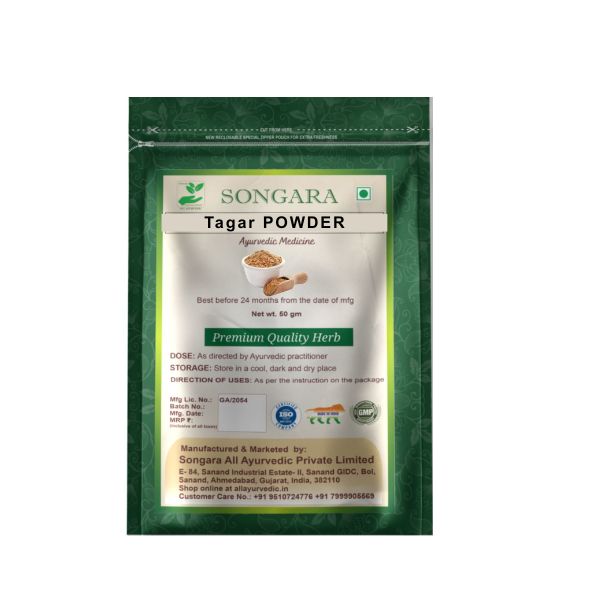
Songara All Ayurvedic
Tagar Powder (Valeriana Jatamansi) – The Ayurvedic Wonder Herb
Tagar Powder (Valeriana Jatamansi) – The Ayurvedic Wonder Herb
पिकअप उपलब्धता लोड गर्न सकिएन
🌿 Tagara (तगर) / Indian Valerian
Botanical Name: Valeriana jatamansi Jones (Syn. V. wallichii DC.)
Family: Valerianaceae
English Name: Indian Valerian / Spikenard
Part Used: Rhizome and Root
Classical Reference: Charaka Samhita – Śītapraśamana Mahākāṣāya, Sushruta Samhita – Elādi Gana
🔹 1. Synonyms (पर्याय नाम)
| Sanskrit Name | Derivation & Meaning |
|---|---|
| तगर (Tagara) | “गीर्यन्ते प्राणाः अनेन इति गरं” — acts against poisons; therefore known as Tagara. |
| कालानुसार्यम् (Kālānusāryam) | “कालमनुसरति शीतोष्णाभ्यामिति” — effective in both cold and hot seasons. |
| कुटिलम् (Kuṭilam) | From vakra (crooked), referring to its twisted rhizomes. |
| नहुषम् (Nahuṣam) | Aromatic and important among antidotes. |
| नतम् (Natam) | Slightly curved rhizomes resembling a bowed form. |
| पिण्डतगरम् (Piṇḍatagaram) | Rootstock appearing as rounded lumps (piṇḍa). |
| दण्डहस्ती (Daṇḍahastī) | “Like the trunk of an elephant,” referring to the shape of rhizomes. |
| बर्हिणम् (Barhiṇam) | Resembling a peacock feather in appearance and fragrance. |
Both varieties (Tagara and Piṇḍatagara) are described as:
“Uṣṇam, Svādu, Snigdham, Laghu” — Hot in potency, sweet in taste, unctuous and light in digestion.
They pacify all three doṣas (Vāta, Pitta, Kapha) and are effective against poison, epilepsy, colic, and eye diseases.
🔹 2. Regional Names
| Language | Name |
|---|---|
| Hindi | Tagar, Sugandhabala, Mushkabala |
| Bengali | Taggera, Usara, Saru Tagora |
| Marathi | Tagar, Tagaramula, Ganthoda |
| Gujarati | Tagar Ganthoda |
| Punjabi | Balamushka, Mushkavali |
| Tamil | Tagarai |
| Malayalam | Tagaram |
| English | Indian Valerian / Spikenard |
🔹 3. Botanical Description
Scientific Name: Valeriana jatamansi Jones
Synonyms: Valeriana wallichii DC.
Family: Valerianaceae
- Habitat: Grows in the temperate Himalayas at altitudes of 1500–3000 m, especially in Kashmir, Khasiya and Jaintia Hills.
- Type: Slightly hairy, tufted perennial herb up to 45 cm high.
- Roots & Rhizomes: Thick, horizontal, aromatic, yellowish-brown, sub-cylindrical, often slightly curved.
- Leaves: Radical leaves persistent, long-petioled, deeply cordate-ovate; cauline leaves smaller, entire or pinnate.
- Flowers: White or pinkish, borne in terminal corymbs.
- Fruits: Oblong, compressed, hairy or glabrous.
- Flowering & Collection: Flowers in April–June; roots harvested in autumn and sun-dried.
- Market Form: Dull yellowish-brown rhizomes 4–12 mm thick, possessing a strong characteristic odour.
🔹 4. Chemical Constituents
The rhizomes and roots contain multiple volatile and non-volatile bioactive compounds, including:
- Sesquiterpenoids: Jatamansone, Nardol, Nardostachone, Nardostahonol, Patchouli alcohol, β-Patchoulene, Seychellane, Seychellene, Jatamols A & B
- Alkaloids: Actinidine, Valeranone, Valeranal, Jatamansin, Jatamansinol
- Iridoid Derivatives (Valepotriates): Valerosidatum, Valtrate, Didrovaltrate — known tranquilizers and sedatives
- Lignans: (+)-Pinoresinol, (+)-1-hydroxypinoresinal, Oroselol
- Triterpenes & Sterols: β-Sitosterol, α- and β-Pinenes, Calarenol, Calarenes
- Other Compounds: Carotene, Elemol, Angelcin, Jatamansic acid, n-Hexacosane, n-Hexacosanol, Isovalerate esters, Aromatic aldehydes
Pharmacological Note:
Recent studies identified valepotriates as major active principles that exhibit sedative, tranquillizing, anticonvulsant, and hypotensive properties comparable to meprobamate in modern pharmacology.
🔹 5. Properties and Therapeutic Uses (गुण एवं औषधीय उपयोग)
Rasa (Taste): Tikta (bitter), Kaṭu (pungent)
Guna (Qualities): Laghu (light), Snigdha (unctuous)
Virya (Potency): Uṣṇa (hot)
Vipāka (Post-digestive effect): Kaṭu
Doshaghna: Balances Vāta, Pitta, and Kapha
Ayurvedic Actions
- Vishaghna: Antidotal and detoxifying
- Unmādahara: Relieves mental disorders and hysteria
- Shūlahara: Alleviates colic pain
- Netrahita: Beneficial in eye disorders
- Vātānulomana: Regulates the nervous and motor systems
- Stambhanīya: Sedative and tranquillizing
Therapeutic Indications
- Nervous and Psychological Disorders
- Useful in hysteria, hypochondriasis, insomnia, nervous restlessness, anxiety, and Parkinson’s disease.
- Acts as a mild CNS depressant and sedative without addiction risk.
- Cardiac and Circulatory Disorders
- Relieves palpitations, anxiety-induced tachycardia, and fainting (syncope).
- Oil (2–5 drops) given with cinnamon infusion improves circulation.
- Respiratory Conditions
- Effective in bronchial asthma and chronic cough.
- Decoction acts as a bronchodilator and relaxes smooth muscles.
- Pain, Inflammation, and Rheumatism
- Infusion used in rheumatic joint swellings, painful wounds, and ulcers.
- Local application aids in fracture healing and reduces pain.
- Digestive Disorders
- Corrects nervous dyspepsia, flatulence, and intestinal colic.
- Stimulates appetite in chronic fevers and weakness.
- Antimicrobial and Healing Activity
- Exhibits antibiotic properties against Micrococcus pyogenes var. aureus and Entamoeba histolytica.
- Used as incense in perfumery and as a natural insect repellant.
- Postpartum and Reproductive Health
- Decoction given in Nepal after childbirth as a uterine sedative and nervine tonic.
- Diabetes & Polyuria due to Stress
- Given with minute doses of Opium or Yasada Bhasma to manage stress-related urination.
- 🔹 6. Dose (मात्रा)
| Preparation | Dosage | Anupana (Vehicle) |
|---|---|---|
| Churna (Powder) | 1–4 g | Honey, Warm water, or milk |
| Taila (Essential Oil) | 2–5 drops | With gum or cinnamon infusion |
| Kashaya (Decoction) | 10–20 ml | Twice daily |
| Root extract (for external use) | As required | For massage or wound healing |
⚕️ Summary
Tagara (Valeriana jatamansi) is a time-honored Ayurvedic tranquillizer, described as a divine herb that calms the mind, steadies the nerves, and restores inner balance. Its potent volatile oils and valepotriates make it an ideal remedy for insomnia, anxiety, hysteria, palpitation, asthma, and neural disorders.
Key Benefits:
🌸 Promotes deep natural sleep and mental calmness
🌿 Relieves anxiety, tension, and emotional restlessness
💪 Reduces pain, inflammation, and nervous exhaustion
🧘♀️ Balances Vāta and Pitta doshas
✨ Enhances concentration and cognitive harmony
Ref: Bhavaprakash Nighantu
सामग्री
सामग्री
ढुवानी र रिटर्न
ढुवानी र रिटर्न
आयामहरू
आयामहरू
हेरचाह निर्देशनहरू
हेरचाह निर्देशनहरू
सेयर गर्नुहोस्