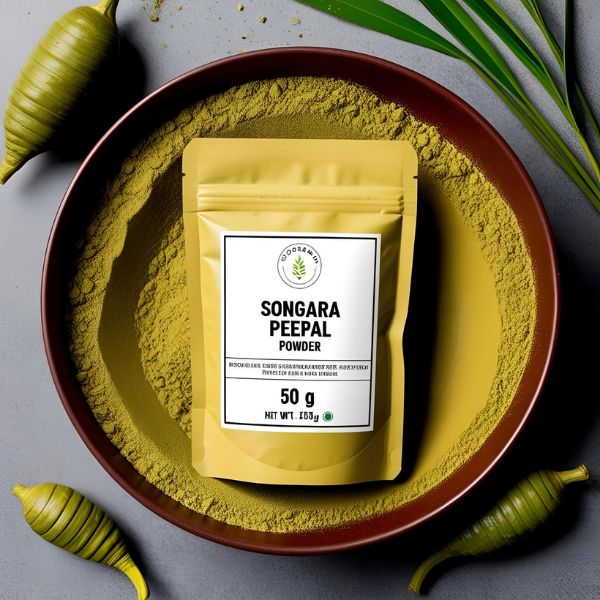
Songara All Ayurvedic
Peepal Powder : A Pure Ayurvedic Herb – Piper Longum
Peepal Powder : A Pure Ayurvedic Herb – Piper Longum
पिकअप उपलब्धता लोड गर्न सकिएन
🌳 Peepal (Pippalaḥ / पिप्पलः)
Botanical Name: Ficus religiosa Linn.
Family: Moraceae
English Name: Sacred Fig / Peepal Tree
Part Used: Bark, Leaves, Fruits, Latex, Roots
1. Synonyms (पर्यायवाची नाम / Synonyms with Meaning)
Sanskrit Synonyms:
बोधिद्रुः (Bodhidruh), पिप्पलः (Pippalah), अश्वत्थः (Aśvatthaḥ), चलपत्रः (Chalapatraḥ), गजाशनः (Gajāśanaḥ)
Etymological Meanings:
- बोधिद्रुः (Bodhidruh): The sacred tree under which Lord Buddha attained enlightenment (bodhi).
- पिप्पलः (Pippalah): Derived from “पल् गतौ” — means that which moves, referring to its continuously trembling leaves.
- अश्वत्थः (Aśvatthaḥ): “Where horses rest” — horses often stand under it for shade.
- चलपत्रः (Chalapatraḥ): “With moving leaves” — due to long slender petioles, leaves quiver even in gentle wind.
- गजाशनः (Gajāśanaḥ): “Eaten by elephants” — elephants are fond of its leaves.
2. Regional Names (प्रादेशिक नाम / Regional Names)
| Language | Name |
|---|---|
| Hindi | Peepal / Pipala (पीपल) |
| Bengali | Ashwattha (অশ্বত্থ) |
| Marathi | Pimpala (पिंपळ) |
| Gujarati | Piplo (પીપળો) |
| Tamil | Arasa / Asvattham (அரச மரம்) |
| Telugu | Raavi (రావిచెట్టు) |
| Kannada | Arali (ಅರಳಿ) |
| Santali | Hesaka |
| English | Sacred Fig / Bo Tree |
| Sanskrit | Bodhivṛkṣa, Pippala, Ashvattha |
3. Botanical Description (वनस्पति विवरण / Botanical Description)
- Botanical Name: Ficus religiosa Linn.
- Family: Moraceae
- Habitat: Common throughout India; sacred and often found near temples.
- Nature: Large, glabrous, deciduous tree; epiphytic when young with spreading branches.
- Height: Up to 30 meters.
- Bark: Smooth, light grey to brown, exudes milky latex when cut.
- Leaves: Broadly ovate, long-tipped, glossy, and pendulous. Long petioles cause constant leaf movement even in mild breeze.
- Fruits: Small, sessile, axillary pairs; depressed globose; green when unripe and turn purple or black when ripe.
- Flowers: Minute, unisexual, contained within the fig-like receptacle.
- Root: Aerial roots develop from branches and reach the ground.
🪷 Special Note:
Peepal is considered sacred in Hinduism, Buddhism, and Jainism — symbolizing the trinity of Brahma, Vishnu, and Shiva. It is worshipped as Kalpavriksha, the “wish-fulfilling tree.”
It is also a pollution-tolerant species, used for reducing air pollution and improving environmental quality around industrial areas.
4. Chemical Constituents (रासायनिक संघटक / Chemical Constituents)
From Bark:
- β-Sitosteryl-D-glucoside
- Vitamin K
- n-Octacosanol
- Methyl oleonate
- Lanosterol
- Stigmasterol
- Lupen-3-one
- From Fruits:
- 4.9% Protein (rich in isoleucine & phenylalanine)
- Dietary fibers with hypocholesterolemic activity
- Phytosterols
- From Latex:
- Proteolytic enzymes
- Resins and Caoutchouc
- Pharmacological Findings:
- Chloroform extract of fruits: Exhibits anti-tumor and anti-bacterial activities.
- Aqueous bark extract: Bacteriostatic against Staphylococcus aureus and Escherichia coli.
- References:
- Ayurvedic Treatise Vol. 1, p. 46–47
- Wealth of India, Supplement Vol. III, p. 131
5. Properties & Therapeutic Uses (गुण, कर्म एवं औषधीय उपयोग)
| Ayurvedic Attributes | Description |
|---|---|
| Rasa (Taste) | Kashaya (Astringent), Madhura (Sweet) |
| Guna (Quality) | Guru (Heavy), Ruksha (Dry) |
| Virya (Potency) | Sheeta (Cold) |
| Vipaka (Post-digestive effect) | Madhura |
| Doshakarma (Effect on Doshas) | Pacifies Pitta and Kapha |
| Prabhava (Special action) | Mutrasangrahaniya (Urine-retaining), Vrana-shodhaka (wound healer) |
Therapeutic Actions:
- Pittashleshmahara – Alleviates pitta and kapha doshas.
- Raktapittaghna – Useful in bleeding disorders.
- Vrana-shodhaka – Cleanses wounds and ulcers.
- Mutrasangrahaniya – Reduces excessive urination.
- Yoni-shodhana – Purifies the female reproductive tract.
- Varnya – Enhances complexion.
- Kashaya rasa – Useful in healing, inflammation, and tissue repair.
6. Therapeutic Uses (औषधीय प्रयोग)
- Vomiting & Hiccup:
- The ash of bark, dissolved in water and decanted, is administered to relieve vomiting and hiccups.
- Gonorrhoea & Urinary Disorders:
- Decoction of bark helps relieve inflammation of urinary tract and gonorrhoea.
- Wound Healing:
- Decoction of bark or Panchavalkala (combination of barks of five trees: Peepal, Banyan, Udumbara, etc.) used for washing wounds.
- Female Genital Disorders:
- Bark decoction used as yoni prakshalana (vaginal douche) to purify and heal genital infections.
- Antibacterial:
- Bark extract acts against Staphylococcus aureus and E. coli infections.
- Bleeding Disorders:
- Bark decoction used internally to control raktapitta (epistaxis, bleeding gums).
- Anti-inflammatory & Cooling:
- Useful in burning sensation, ulcers, and pitta-related conditions.
7. Dosage (मात्रा एवं उपयोग विधि)
Bark Powder (Churna)
3–5 g twice daily with honey or water
Fruit Powder
5–10 g daily
8. Classical References
- Charaka Samhita (Sū. Ch. 4): Mentioned in Mutrasangrahaniya Mahakashaya
- Charaka (Vi. Ch. 8): Included in Kashaya Skandha
- Sushruta Samhita (Su. Ch. 38): Part of Nyagrodhādi Gana
9. Modern Research & Environmental Value
- Anti-tumor, Anti-bacterial, Hypocholesterolemic, and Wound-healing properties validated in studies.
- Environmental Role: Excellent air purifier, reduces noise and ambient temperature; suitable for urban plantation.
- Ecological Importance: Host plant for the lac insect (Laccifer lacca), used in natural resin production.
🌿 Conclusion
Peepal (Pippalaḥ) is both a sacred and medicinal tree, deeply integrated in Indian culture and Ayurveda.
Its bark, leaves, fruits, and latex offer therapeutic value in skin, urinary, bleeding, and inflammatory disorders.
It is a pitta-kapha pacifier, coolant, astringent, and rejuvenating — truly a "Kalpavriksha" (Tree of Life) of Ayurveda.
Ref: Bhavaprakash Nighantu
सामग्री
सामग्री
ढुवानी र रिटर्न
ढुवानी र रिटर्न
आयामहरू
आयामहरू
हेरचाह निर्देशनहरू
हेरचाह निर्देशनहरू
सेयर गर्नुहोस्