Songara All Ayurvedic
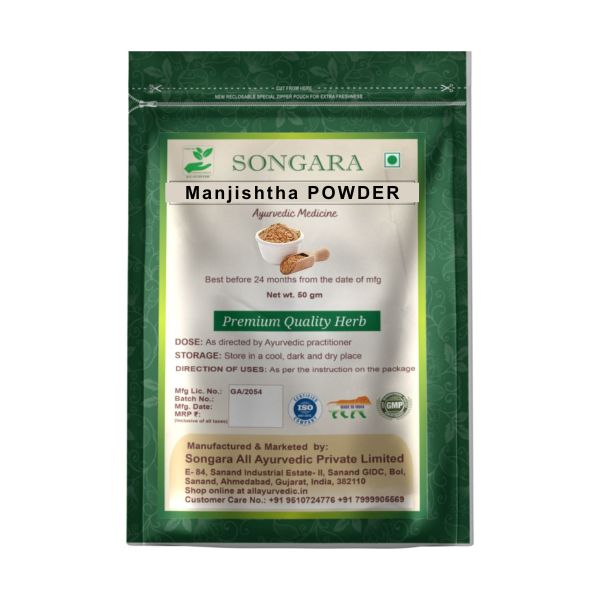
Manjishtha Powder : A Pure Ayurvedic Herb – Rubia Cordifolia
Manjishtha Powder : A Pure Ayurvedic Herb – Rubia Cordifolia
पिकअप उपलब्धता लोड गर्न सकिएन
🌿 Manjistha (मञ्जिष्ठा)
Botanical Name: Rubia cordifolia Linn.
Family: Rubiaceae
English Name: Indian Madder
1. Synonyms
Sanskrit Names:
मञ्जिष्ठा (Manjistha), विकसा (Vikasa), जिङ्गी (Jingi), समङ्गा (Samanga), कालमेषिका (Kalameshika), मण्डूकपर्णी (Mandukaparnī), भण्डीरी (Bhandirī), भण्डी (Bhandī), योजनवल्ली (Yojanavallī), रसायनी (Rasayanī), अरुणा (Arunā), काला (Kālā), रक्ताङ्गी (Raktāṅgī), रक्तयष्टिका (Raktayaṣṭikā), भण्डीतकी (Bhaṇḍītakī), गण्डीरी (Gaṇḍīrī), मञ्जूषा (Manjūṣā), वस्त्ररञ्जिनी (Vastrarañjinī).
Etymological Derivations & Meanings:
- मञ्जिष्ठा: “That which imparts beauty and redness,” known for purifying blood and enhancing complexion.
- विकसा / जिङ्गी / योजनवल्ली: Refers to its climbing and spreading nature.
- अरुणा / रक्ताङ्गी / रक्तयष्टिका: Indicates its red-colored stems and roots.
- रसायनी: Possesses rejuvenative (Rasayana) properties.
- वस्त्ररञ्जिनी: Used as a natural dye for coloring fabrics.
2. Regional Names
- Hindi: Majitha, Manjistha
- Bengali: Manjistha
- Gujarati: Majitha
- Telugu: Manjistha-tithi, Tamravalli
- Tamil: Manjitti, Manditta
- Malayalam: Punta
- Punjabi: Kukaraphali, Seni, Runanga, Mitu, Manjita
- Kashmiri: Dandu
- Assamese: Majathi
- Khasi Hills: Hyoi
- Naga: Enahu
- Manipuri: Mayuma
- English: Indian Madder
3. Botanical Description
Rubia cordifolia is a herbaceous climbing creeper, common throughout the hilly regions of India, especially from the north-western Himalayas to the eastern regions, ascending up to 2500 meters.
- Stem: Scandent, woody below, quadrangular, and rough (scabrid).
- Leaves: Arranged in whorls of four, ovate, heart-shaped (cordate), rough on both surfaces.
- Flowers: Small, greenish-yellow, borne in terminal panicled cymes.
- Fruits: Small, globose or didymous berries that turn black when ripe.
- Flowering & Fruiting Season: August to October.
4. Chemical Constituents
The root and aerial parts of Manjistha contain several bioactive compounds, primarily anthraquinones and triterpenes, which account for its therapeutic and dyeing properties.
Major Constituents Include:
- Anthraquinones: Munjiṣtin (xanthopurpurin-2-carboxylic acid), Purpurin, Alizarin, Physcion, Nordamnacanthol, Pseudopurpurin, Purpuroxanthin, Rubiadin, Xanthopurpurin.
- Cyclic Hexapeptides: RA-I, RA-II, RA-III, RA-IV, RA-V, RA-VII – known for antitumour properties.
- Flavonoids and Coumarins: Scopoletol, Rubicoumaric acid, Rubifolic acid.
- Sterols: β-sitosterol.
- Triterpenes: Oleanolic acid acetate, Rubiatriol.
- Other constituents include 2-methyl-1,3,6-trihydroxy anthraquinone and its derivatives.
Pharmacological Studies:
- Antitumour and Antimicrobial activity (effective against Staphylococcus aureus).
- Hypoglycaemic effect (ethanolic extract tested in albino rats).
- Root decoction imparts red coloration to urine and bones due to anthraquinone pigments.
5. Properties and Therapeutic Uses
Rasa (Taste): Madhura (sweet), Tikta (bitter), Kashaya (astringent)
Guna (Quality): Guru (heavy)
Virya (Potency): Ushna (hot)
Vipaka (Post-digestive effect): Madhura
Doshic Action: Pacifies Kapha and Pitta doshas.
Therapeutic Actions:
- Raktaprasadana: Purifies and improves the quality of blood.
- Varnya: Enhances complexion and promotes glowing skin.
- Viṣaghna: Acts as a detoxifier in poisoning.
- Jvarahara: Useful in fevers with pitta involvement.
- Rasayana: Promotes rejuvenation and vitality.
- Shothahara: Reduces inflammation and swelling.
- Kusthaghna: Useful in various skin diseases.
Medicinal Uses:
- Blood and Skin Disorders: Decoction (Manjisthadi Kwatha) used in eczema, psoriasis, leucoderma, and hyperpigmentation.
- Postpartum Uterine Cleanser: Combined with Isaramula and Pippalimula to enhance uterine contraction and purification.
- Renal Calculi: Powder (1 g thrice daily) given for few weeks before surgery to ease urinary flow.
- Rickets, Tuberculosis & Chronic Diarrhoea: Acts as tonic and anti-inflammatory; relieves pain in pleurisy and enteritis.
- Diabetes (Manjisthameha): Decoction with Candana (Sandalwood) is prescribed.
- Skin Care:
- Paste with honey for black spots, dermatitis, leucoderma.
- Paste with Lodhra and Candana for erysipelas.
- Bone & Joint Disorders: Decoction of Manjistha, Arjuna, Yashtimadhu, and Tagara promotes bone healing; paste applied externally.
- Burns and Ulcers: Ghee prepared with Manjistha, Candana, and Murva helps in healing burn wounds.
- Liver Disorders: Seeds used in hepatic obstruction and jaundice.
Note: In small doses, Manjistha acts as a mild sedative; in higher doses, it may cause dizziness.
6. Dose
- Powder (Churna): 1–3 grams, two to three times a day with lukewarm water or honey.
- Decoction (Kwatha): 30–50 ml, once or twice daily.
- External Application: Paste of roots or leaves used in various skin disorders and inflammatory conditions.
Summary
Manjistha is a powerful Ayurvedic herb revered as a blood purifier, complexion enhancer, and anti-inflammatory tonic. Its unique combination of anthraquinones and triterpenes makes it effective in skin diseases, liver ailments, and detoxification therapies. Traditional texts recognize Manjistha as a vital Rasayana dravya, ensuring vitality, clear skin, and internal balance.
Ref: Bhavaprakash Nighantu
सामग्री
सामग्री
ढुवानी र रिटर्न
ढुवानी र रिटर्न
आयामहरू
आयामहरू
हेरचाह निर्देशनहरू
हेरचाह निर्देशनहरू
सेयर गर्नुहोस्