1
/
of
5
Songara All Ayurvedic
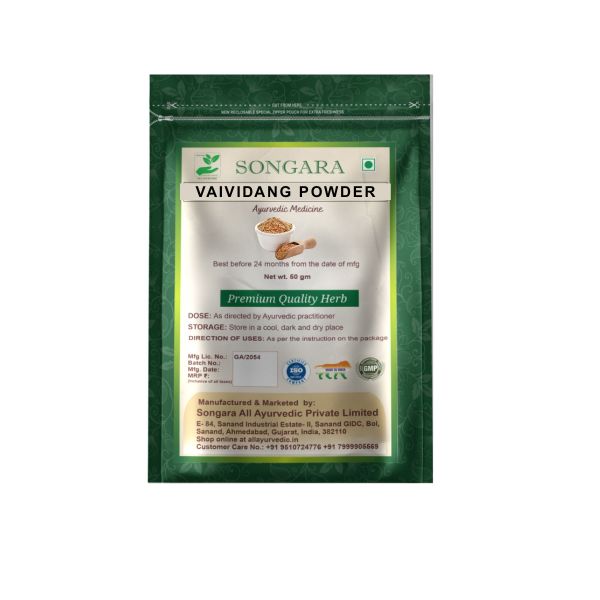
Vaividang Powder (Embelia ribes) – The Ayurvedic Detox Herb
Vaividang Powder (Embelia ribes) – The Ayurvedic Detox Herb
Regular price
Rs. 180.00
Regular price
Rs. 198.00
Sale price
Rs. 180.00
Taxes included.
Shipping calculated at checkout.
No reviews
Quantity
Couldn't load pickup availability
🌿 Vaividang (Vidanga) / Embelia ribes Burm.f.
Family: Myrsinaceae
Part Used: Dried Fruit (Seeds)
1. Synonyms (पर्याय / समानार्थक नाम)
Sanskrit Synonyms:
- विडङ्गम् (Vidangam): ‘विडति भिनत्ति इति’ — That which removes digestive obstruction, pain, and worms.
- कृमिघ्नः (Krumighna): Destroyer of worms and parasites.
- जन्तुनाशनः (Jantunāśanaḥ): Annihilator of intestinal worms.
- तण्डुलः (Tandulah): Its seeds resemble rice grains.
- वेल्लम् (Vellam): Having drooping branches.
- अमोघा (Amoghā): Possesses definite, infallible anthelmintic action.
- चित्रतण्डुलः (Chitra-Tandulah): Having beautifully mottled seeds.
- English Names: False Black Pepper, Embelia, Vidang
- Botanical Name: Embelia ribes Burm.f.
2. Regional Names
| Language | Regional Name |
|---|---|
| Hindi | बायविडंग (Bāyavidang), बाभिरंग (Bābhirang) |
| Bengali | विरंग (Virang) |
| Marathi | वावडिंग (Vāvading) |
| Gujarati | वायवडंग (Vayavadang) |
| Kannada | वायुविडंग (Vayuvidanga), वायविलंग (Vayavilang) |
| Telugu | वायुविडंघमु (Vayuvidanghamu) |
| Tamil | Vayavidangam |
| Malayalam | Vijhala |
| English | False Black Pepper |
| Sanskrit | Vidangam |
3. Botanical Description
- Habit: Large scandent (climbing) shrub, commonly found in the hilly regions throughout India.
- Leaves: Elliptic-oblong, leathery, smooth, entire, shiny above, paler beneath; petiole often glandular.
- Flowers: Small, greenish-yellow to white; borne on pedicels longer than the flowers.
- Fruits: Round berries, black when ripe, wrinkled when dry; aromatic, pungent taste.
- Seeds: Solitary, globose, reddish-brown to black.
- Flowering: August–September
- Fruiting: October–December
- Habitat: Western Ghats, Himalayas, Bengal, Assam, and parts of Madhya Pradesh.
4. Chemical Constituents
Major Active Compounds:
- Embelin: 2,5-dihydroxy-3-lauryl-p-benzoquinone (main anthelmintic principle, 2.5–3.1%)
- Christembine (Alkaloid)
- Homoemblin and Homorapanone
- Vilangine: Methylene-bis-(2,5-dihydroxy-4-undecyl-3,6-benzoquinone)
- Quercitol (1.0%)
- Fatty oil, Resinoids, Tannins, and Trace Volatile Oils
Pharmacological Activities (Modern Studies):
- Anthelmintic (especially against Ascaris lumbricoides)
- Antibacterial (active against Staphylococcus aureus and E. coli)
- Carminative, Antioxidant, Anti-inflammatory
5. Properties and Therapeutic Uses (गुण, कर्म, उपयोग)
Ayurvedic Properties
| Rasa (Taste) | Katu (Pungent) |
|---|---|
| Guna (Qualities) | Laghu (Light), Ruksha (Dry), Tikshna (Sharp) |
| Virya (Potency) | Ushna (Hot) |
| Vipaka (Post-digestive Effect) | Katu |
| Doshic Action | Pacifies Kapha and Vata doshas |
Classical References & Mentions:
- Charaka Samhita: Listed under Krumighna Mahakashaya, Trptighna, Kusthaghna, Sirovirecana Dravya.
- Sushruta Samhita: Included in Surasadi Gana and Pippalyadi Gana.
- Described as: “Krumighna-shreshtha” — the best among worm-destroying herbs.
Pharmacological & Therapeutic Actions (Karma):
- Krumighna: Destroys intestinal worms
- Deepana: Stimulates digestive fire
- Pachana: Aids digestion
- Rasayana: Rejuvenative and restorative
- Grahi: Absorbent, reduces excessive discharge
- Lekhana: Reduces excess fat and toxins
- Medhya: Improves intellect and mental clarity
Therapeutic Uses:
- Intestinal Worms (Krumiroga):
- Most effective against roundworms (Ascaris lumbricoides).
- Given with honey or curd, followed by a mild purgative after 4 hours.
- Digestive Disorders:
- Relieves abdominal pain, flatulence, indigestion, and distension.
- Skin Diseases (Kustha):
- Used internally and externally in various chronic skin disorders.
- Childhood Disorders:
- Used in pediatric emaciation, indigestion, and distension (boiled with milk).
- Lymphatic Disorders / Scrofula:
- Given with Guggulu, Manahsila, Shankha bhasma, and honey.
- Respiratory Ailments:
- Beneficial in dyspnea, cough, and catarrh (used as nasal medication with milk).
- Neurological Conditions:
- Used in hemiplegia, convulsions, epilepsy with Rasona and milk.
- Urinary Disorders (Mutrakriccha):
- Used in turbidity of urine and cystitis (fresh fruits recommended).
- Toxic Conditions:
- Helpful in scorpion sting and snake bite (as supportive herbal aid).
- Rejuvenative Therapy (Rasayana):
- Mentioned in Sarvopaghata-Samaniya Adhyaya of Sushruta Samhita.
- Promotes intellect, strength, and vitality.
6. Doses and Administration
Form Dose Anupana (Vehicle)
Powder (Churna) 4–16 g Honey, Curd, or Milk
- Avoid in excessive Pitta conditions.
- Prolonged use should be under Ayurvedic supervision.
- Not to be taken in pregnancy without advice.
Summary Table
| Aspect | Details |
|---|---|
| Botanical Name | Embelia ribes Burm.f. |
| Family | Myrsinaceae |
| Part Used | Dried Fruit |
| Active Constituents | Embelin, Christembine, Vilangine, Quercitol |
| Actions | Anthelmintic, Carminative, Digestive, Rasayana |
| Primary Indications | Worm infestation, Indigestion, Skin disorders, Piles |
| Taste (Rasa) | Katu (Pungent) |
| Potency (Virya) | Ushna (Hot) |
| Effect on Dosha | Pacifies Kapha & Vata |
| Dose | 4–16 g of powder with honey or milk |
Ref: Bhavaprakash Nighantu
Materials
Materials
Shipping & Returns
Shipping & Returns
Dimensions
Dimensions
Care Instructions
Care Instructions
Share
No reviews