Songara All Ayurvedic
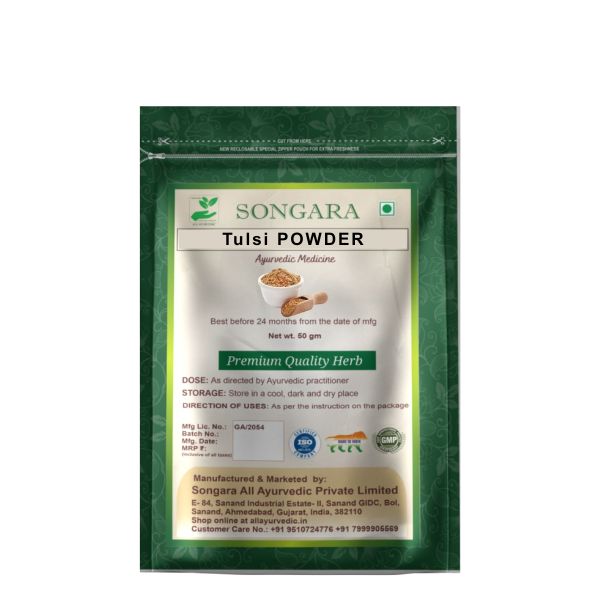
Tulsi Powder – The Sacred Ayurvedic Herb for Holistic Wellness
Tulsi Powder – The Sacred Ayurvedic Herb for Holistic Wellness
Couldn't load pickup availability
🌿 Tulsi (Ocimum sanctum Linn.)
Family: Lamiaceae (Labiatae)
English Name: Sacred Basil / Holy Basil
Hindi Name: तुलसी
1. Synonyms (पर्याय)
Tulasi, Surasā, Grāmya, Sulabhā, Bahumañjarī, Apetarākṣasī, Gaurī, Bhūtaghnī, Devadundubhiḥ
Etymological Meaning:
- Tulasi: "Tulyate iti Tulasi" — incomparable among herbs.
- Surasā: having beautiful taste and usefulness in many disorders.
- Grāmya: grows abundantly in villages and homes.
- Sulabhā: easily available everywhere.
- Bahumañjarī: having numerous floral spikes.
- Apetarākṣasī / Bhūtaghnī: destroys harmful microorganisms and evil influences.
- Gaurī: symbol of purity and divinity.
- Devadundubhiḥ: flowers resemble the celestial trumpet (dundubhi).
2. Regional Names (प्रादेशिक नाम)
- Hindi: Tulasi (तुलसी)
- Bengali: Tulasi
- Marathi / Gujarati: Tulasa / Tulasi
- Telugu: Tulasi, Krishna Tulasi
- Tamil: Thulasi (துளசி)
- Kannada: Vishnu Tulasi, Kari Tulasi, Sri Tulasi
- Malayalam: Trittavu (ത്രിത്താവ്)
- English: Sacred Basil / Holy Basil
3. Botanical Description (वनस्पति विवरण)
Scientific Name: Ocimum sanctum Linn.
Family: Lamiaceae (Labiatae)
Tulsi is an erect, herbaceous, much-branched, softly hairy annual or perennial aromatic plant, cultivated throughout India and commonly found in courtyards and temple areas.
- Stem: Quadrangular, branched, and slightly hairy.
- Leaves: Opposite, elliptic-oblong, entire or serrate, green or purple depending on the variety (Śrītulasi – green type, Kṛṣṇa Tulasi – purple type).
- Flowers: Small, purplish or crimson, arranged in racemes; calyx lobes five, petals five, and staminal tube as long as petals.
- Fruits: Nutlets, sub-globose, pale brown or reddish, containing small seeds.
- Flowering Season: Throughout the year in tropical climates.
Tulsi is considered sacred by Hindus and planted in almost every household for its spiritual and medicinal value.
4. Chemical Constituents (रासायनिक संघटन)
Tulsi contains a wide range of bioactive constituents including essential oils, phenolic compounds, and flavonoids.
Major Constituents:
- Volatile oils: Bornyl acetate, cadinene, camphene, camphor, caryacrol, β-caryophyllene, 1,8-cineole, decylaldehyde, eugenol, eugenol methyl ether, humulene, limonene, methylchavicol, nerol, α- & β-pinenes, γ-selinene, terpen-4-ol.
- Fatty acids: Linoleic, linolenic, oleic, palmitic, and stearic acids.
- Vitamins & Pigments: Ascorbic acid (Vitamin C), β-carotene.
- Flavonoids: Apigenin, luteolin and their glucuronides, molludistin, oreantin.
- Triterpenoid: Ursolic acid.
These compounds impart Tulsi with its antibacterial, antiviral, antioxidant, and adaptogenic properties.
5. Properties and Therapeutic Uses (गुण एवं चिकित्सीय उपयोग)
Ayurvedic Properties:
- Rasa (Taste): Katu (Pungent), Tikta (Bitter)
- Guna (Quality): Laghu (Light), Ruksha (Dry)
- Virya (Potency): Ushna (Hot)
- Vipaka (Post-digestive effect): Katu
- Dosha Karma: Pacifies Kapha and Vata doshas, aggravates Pitta.
- Actions:
- Deepana (Digestive stimulant)
- Kaphahara (Expectorant)
- Vatahara (Reduces Vata)
- Krimighna (Anthelmintic)
- Shwasahara (Relieves cough and asthma)
- Jantughna (Antimicrobial)
- Hridya (Cardiac tonic)
- Vishaghna (Antitoxic)
- Therapeutic Uses:
- Respiratory Disorders: Beneficial in cough, cold, bronchitis, asthma, pleurisy, and catarrh.
- Digestive Health: Stimulates appetite and aids in digestion; effective in dyspepsia and intestinal worms.
- Fever & Infections: Decoction of leaves or root is used in malarial and intermittent fevers as a diaphoretic.
- Skin Diseases: Effective in ringworm, eczema, and insect bites due to its antiseptic and antimicrobial action.
- Blood & Liver: Purifies blood, aids liver function, and corrects disorders of the hepatobiliary system.
- Nervous System: Acts as an adaptogen, reduces stress, anxiety, and fatigue.
- ENT Disorders: Tulsi leaf juice is instilled into ears to relieve earache.
- Reproductive & Urinary Disorders: Seeds are mucilaginous, demulcent, and used in genito-urinary tract irritation and dysuria.
- General Tonic: Strengthens immunity, enhances vitality, and promotes longevity.
6. Dose and Parts Used (प्रयोग मात्रा एवं उपयोगी भाग)
- Parts Used: Leaves, Seeds, Roots, Whole Plant
- Juice of Leaves (Svarasa): 5–10 ml daily
- Decoction (Kwatha): 20–40 ml
- Powder (Churna): 1–3 g with honey or warm water
- Fresh Leaves: Can be chewed daily for immunity and oral hygiene.
Summary:
Tulsi — “The Incomparable One” — is not just a sacred plant but a versatile medicine. It balances Vata and Kapha, acts as a natural antibiotic, antioxidant, and adaptogen, and is essential in respiratory, skin, and digestive ailments. Its aromatic oils (rich in eugenol) make it both therapeutic and preventive, promoting ojas (vital energy) and spiritual purity.
Ref: Bhavaprakash Nighantu
Materials
Materials
Shipping & Returns
Shipping & Returns
Dimensions
Dimensions
Care Instructions
Care Instructions
Share