1
/
of
6
Songara All Ayurvedic
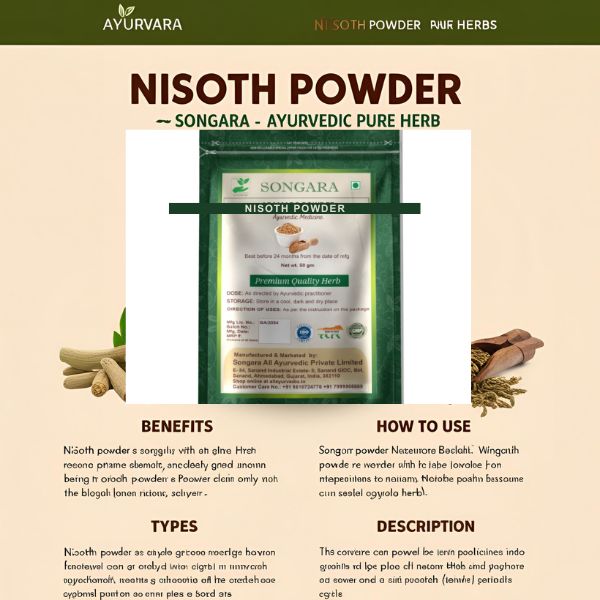
Songara NISOTH Operculina turpethum & Achyranthes aspera – The Ayurvedic Pure Herb (50 Gm)
Songara NISOTH Operculina turpethum & Achyranthes aspera – The Ayurvedic Pure Herb (50 Gm)
Regular price
Rs. 137.00
Regular price
Rs. 145.00
Sale price
Rs. 137.00
Taxes included.
Shipping calculated at checkout.
No reviews
Quantity
Couldn't load pickup availability
NISOTH (Trivrit / Turpeth Root)
Botanical Name: Operculina turpethum (Linn.) Silva Manso
Family: Convolvulaceae
1. Synonyms
Sanskrit: त्रिवृत् (Trivṛt), निष्टोष (Niṣṭhoṣ), श्यामलता (Śyāmalatā), त्रिवल्ली (Trivallī), सुधापुष्पा (Sudhāpuṣpā), तीक्ष्णा (Tīkṣṇā)
English: Turpeth root, Indian Jalap
Synonyms in Classical Texts:
- Ipomoea turpethum R. Br.
- Operculina turpethum (Linn.) Silva Manso
2. Regional Names
| Language | Name |
|---|---|
| Hindi | Nishoth, Trivrit, Nisot |
| Bengali | Nishoth |
| Marathi | Nisoth, Trivrut |
| Gujarati | Nishot |
| Tamil | Sivadai, Tiruvirattai |
| Telugu | Tella Tegada |
| Kannada | Tiruvirinta |
| Malayalam | Tiruvidam |
| English | Turpeth root, Indian Jalap |
3. Botanical Description
Operculina turpethum is a stout perennial twiner with milky juice, found throughout India up to 900 meters altitude.
- Stem: Very long, three-winged or angled, with milky exudate.
- Leaves: Simple, ovate to oblong (5–12.5 cm), cordate base, petiole 1.8–2.5 cm long.
- Flowers: White, funnel-shaped, borne in few-flowered cymes.
- Fruit: Capsule, globose (12–18 mm diameter), enclosed within brittle, enlarged calyx segments.
- Seeds: One per cell, round and black.
-
Root: Long (1.5–5 cm thick), fleshy, externally striated, brown or dark grey, resembling a twisted rope.
It thrives in moist, shady areas, particularly along ditches, and bears abundant white bell-shaped flowers during the rainy season. - The fresh root exudes a milky latex that quickly hardens into a resinous material.
- Note: Some market samples are adulterated with roots of Marsdenia tenacissima.
- 4. Chemical Constituents
- Active Principle: Glycosidic resin (mainly in the root bark).
- Major Compounds:
- α- and β-Turpetheins
- Turpethinic acids (A–E)
- Scopoletin
- Glucose, Fructose, Rhamnose
- Resin glycosides:
- O-β-D-glucopyranosyl
- O-α-L-rhamnopyranosyl
- Dihydroxy fatty acid glycosides
- Other constituents: Hydrolysate of resin, minor alkaloids.
-
Pharmacological Activity:
Alcoholic extracts show antibacterial activity against Micrococcus pyogenes var. aureus and Escherichia coli. - 5. Properties and Therapeutic Uses
- Ayurvedic Properties
- Rasa (Taste): Tikta (Bitter), Katu (Pungent)
- Guna (Quality): Laghu (Light), Tikshna (Sharp)
- Virya (Potency): Ushna (Hot)
- Vipaka (Post-digestive effect): Katu (Pungent)
- Doshakarma: Pacifies Kapha and Pitta doshas.
- Classical References
- Charaka Samhita: Mentioned in Bhedaniya Mahakashaya (group of purgatives).
- Sushruta Samhita: Listed in Shyamadi gana and Adhobhagahara gana (downward purgative group).
- Therapeutic Actions
- Rechana (Purgative) – Powerful laxative that cleanses bowels.
- Bhedana (Deobstruent) – Removes blockages from channels.
- Deepana–Pachana – Stimulates digestion and metabolism.
- Medohara – Reduces excess fat.
- Shothahara – Relieves oedema and inflammation.
- Kusthaghna – Useful in skin disorders.
- Krimighna – Kills intestinal worms.
- Medicinal Uses
- Constipation & Abdominal disorders: Promotes bowel evacuation and relieves obstruction.
- Jaundice & Hepatic congestion: Improves liver function.
- Dropsy & Oedema: Removes excess fluid accumulation.
- Gout & Rheumatism: Eliminates vitiated vata and metabolic waste.
- Skin Diseases: Used internally and externally.
- Fever and Bleeding Disorders: Acts as mild purgative and detoxifier.
- Piles: Helps relieve constipation and venous congestion.
- Melancholia & Mental disorders: Clears accumulated toxins.
- Traditionally combined with Triphala, Pippali, Shunthi, and Hyoscyamus niger to enhance efficacy and reduce griping.
- 6. Dose
-
Powder (Root)
2–5 g with warm water or honey - Caution: Excessive use may cause griping, nausea, or dehydration. Should be taken with Saindhava lavana (rock salt) or ginger to prevent abdominal discomfort.
Contraindicated in pregnancy and weak constitution. - Summary
- Nisoth (Operculina turpethum) is one of Ayurveda’s most powerful natural purgatives — a cleansing herb that clears toxins, stimulates digestion, purifies the blood, and balances Kapha and Pitta doshas. Its potent resinous root has long been revered as a Bhedaniya dravya (purifying herb) and forms a key ingredient in classical formulations for detoxification, liver support, and skin health.
Materials
Materials
Shipping & Returns
Shipping & Returns
Dimensions
Dimensions
Care Instructions
Care Instructions
Share
No reviews