Songara All Ayurvedic
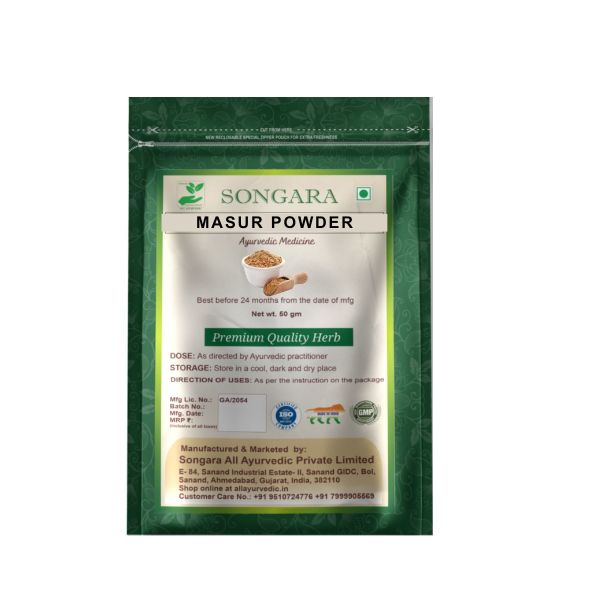
Masur Powder (Lens culinaris) – The Ayurvedic Superfood
Masur Powder (Lens culinaris) – The Ayurvedic Superfood
Couldn't load pickup availability
🌾 Masūra (मसूर)
Botanical Name: Lens culinaris Medik. (Syn. L. esculenta Moench., Ervum lens Linn.)
Family: Fabaceae (Leguminosae)
1. Synonyms (पर्यायनामानि / Classical Names)
| Sanskrit / Classical Name | Meaning / Derivation | Reference |
|---|---|---|
| मङ्गल्यक (Mangalyaka) | That which brings auspiciousness (maṅgala) | Ayurvedic Nomenclature |
| मसूर (Masūra) | Derived from “masyati pariṇamate” — easily digestible and nourishing | Nighaṇṭu Śeṣaṭīkā |
| मसूरिका (Masurikā) | Feminine form of Masūra | Classical synonym |
| मङ्गल्या (Mangalyā) | Auspicious pulse used in sacred and healthful food | Classical synonym |
🪷 Interpretation:
The term “Mangalyaka” signifies purity and wholesomeness — a śāka (legume) considered beneficial, sattvic, and auspicious in the Indian diet and rituals.
2. Regional Names
| Language | Common / Regional Name |
|---|---|
| Hindi | मसूर (Masūr), मसूरी (Masūrī) |
| Bengali | मसुरी (Masuri) |
| Marathi | मसूर (Masur) |
| Gujarati | मसूर (Masur), मसेरा (Massera) |
| Telugu | मिसुरुप्पु (Misuruppu), चिरिसंगलु (Cirisangalu) |
| Kannada | मस्सूर (Massur), चणंगि (Canangi) |
| English | Lentil |
| Tamil | मसूर परुप्पु (Masur Paruppu) |
3. Botanical Description
| Feature | Description |
|---|---|
| Botanical Name | Lens culinaris Medik. |
| Synonyms | L. esculenta Moench., Ervum lens Linn. |
| Family | Fabaceae (Leguminosae) |
| Habit | Small, erect, annual herb with soft pubescence; height 15–75 cm. |
| Leaves | Compound, alternate, with small oval leaflets and tendrils. |
| Flowers | Small, solitary or paired; white, rose, pink, or violet. |
| Fruit (Pod) | Smooth, compressed, 1–2-seeded, about 1–1.5 cm long. |
| Seeds | Lenticular (lens-shaped), smooth; color varies from pale pinkish to deep reddish-brown. |
| Root | Taproot with small lateral nodules (nitrogen-fixing). |
| Habitat & Distribution | Widely cultivated throughout India—especially in Uttar Pradesh, Bihar, Madhya Pradesh, and Bengal plains. Thrives in dry, cool climates. |
| Cultivation | Sown in rabi season; major pulse crop valued since Vedic times. |
4. Chemical Constituents
Major Phytochemicals:
- Phenolic compounds: Indolyl acrylic acid, trans-ferulic acid, syringic acid, trans-p-coumaric acid
- Flavonoids: Luteolin, Tricetin, Kaempferol, 5-deoxy-kaempferol, Proanthocyanidins, Delphinidin glycosides, Variabilin
- Alkaloids: Lenticin (minor)
- Enzymes: Amylase, Proteolytic enzymes, Phosphatase, Phytase
- Saponins: Esculentin (isolated in appreciable amount)
- Proteins: High-quality vegetable protein (25–26%), but deficient in methionine, tryptophan, and threonine
- Carbohydrates: Starch, Hemicellulose, Stachyose, Reducing sugars
- Vitamins: B-complex group (B₁, B₂, B₃, B₆), folic acid
- Minerals:
- Calcium – 38.6 mg/100 g
- Phosphorus – 242 mg/100 g
- Iron – 7.6 mg/100 g
- Potassium – 673 mg/100 g
- Magnesium – 76.5 mg/100 g
- Sulphur – 122 mg/100 g
- Trace elements – Iodine, Bromine, Zinc, Copper, Manganese
5. Ayurvedic Properties (गुण, रस, वीर्य, विपाक, दोषप्रभाव)
| Property | Description |
|---|---|
| Rasa (Taste) | Madhura (Sweet), Kaṣāya (Astringent) |
| Guna (Quality) | Laghu (Light), Rūkṣa (Dry) |
| Virya (Potency) | Śīta (Cooling) |
| Vipāka (Post-digestive effect) | Madhura |
| Doṣa Effect | Pacifies Kapha, Pitta, and Rakta Doṣa; aggravates Vāta Doṣa |
| Karma (Actions) | Saṅgrāhī (Absorbent), Jvaraghna (Antipyretic), Raktapittahara (Blood purifier), Hṛdya (Cardiac tonic), Pathya (Wholesome food) |
6. Properties & Therapeutic Uses (गुण एवं उपयोग)
| Action | Therapeutic Benefit |
|---|---|
| Saṅgrāhī (Astringent) | Useful in diarrhoea, dysentery, and bleeding disorders. |
| Jvaraghna (Antipyretic) | Beneficial in fevers and debility. |
| Raktapittahara (Blood purifier) | Pacifies pitta and purifies blood; used in raktapitta and skin disorders. |
| Balya (Strength promoting) | Nourishing and rejuvenating; builds muscle tissue and vitality. |
| Hṛdya (Cardiac tonic) | Supports heart health due to its cooling and protein-rich nature. |
| Śītala & Pathya (Cooling and Wholesome) | Ideal during convalescence or post-fever recovery; improves digestion without aggravating pitta. |
| Pitta–Kaphahara | Useful in conditions of acidity, skin eruptions, burning sensation, and excessive heat. |
| Vātaghna (with ghee) | If cooked with ghee and mild spices, reduces dryness and pacifies vāta. |
7. Modern Nutritional and Medicinal Uses
- Excellent source of plant protein (second only to Bengal gram in nutritive value).
- Good source of B-vitamins and dietary fiber.
- Low glycemic index — suitable for diabetic diets.
- Aids in muscle recovery and boosts stamina.
- Improves hemoglobin levels due to high iron content.
- Lentil soup (Masoor dal) recommended in convalescence and fever.
8. Dose (मात्रा)
Powder (Cūrṇa) 10–15 g
Boiled with water or made into thin gruel.
9. Formulations & Combinations
- Used in pathya preparations for fever, anaemia, and weakness.
- Cooked with ghee and spices for vāta balance.
- Combined with old rice, ghee, and rock salt for easily digestible diet during convalescence.
- Sometimes used in medicinal khichri with mung dal for light nourishment.
10. Classical References
| Text | Reference |
|---|---|
| Caraka Saṃhitā (Sūtra 27) | Mentions Masūra as a wholesome pulse; pacifies kapha-pitta. |
| Suśruta Saṃhitā | Listed among Śimbīdhānya varga (leguminous group). |
| Āyurveda Prakāśa / Bhāvaprakāśa | Describes Masūra as cold, light, and strengthening. |
| Nighaṇṭu Ratnākara & Dhanvantari Nighaṇṭu | Classified under Māṅgalya Dhānya Varga. |
11. Summary
🌿 Masūra (Lens culinaris) — known as Mangalyaka in classical Ayurveda — is an auspicious, cooling, light, and nutritive legume.
It balances Kapha–Pitta, promotes strength, tissue nourishment, and recovery from illness.
With its high protein, iron, and vitamin B content, Masura is both a food and medicine, widely recommended for convalescence, fevers, anaemia, and digestive health.
Materials
Materials
Shipping & Returns
Shipping & Returns
Dimensions
Dimensions
Care Instructions
Care Instructions
Share