1
/
of
4
Songara All Ayurvedic
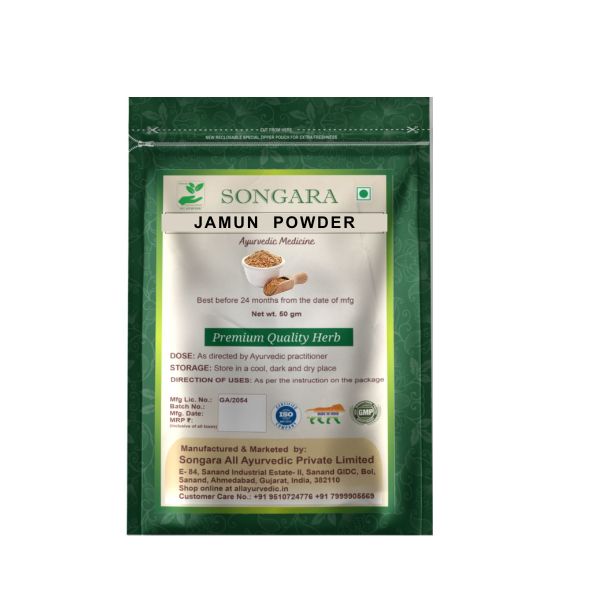
Jamun Powder (Syzygium cumini) – The Ayurvedic Superfood
Jamun Powder (Syzygium cumini) – The Ayurvedic Superfood
Regular price
Rs. 35.00
Regular price
Rs. 39.00
Sale price
Rs. 35.00
Taxes included.
Shipping calculated at checkout.
No reviews
Quantity
Couldn't load pickup availability
🌿 Rājajambū (Jamun / Syzygium cuminii (Linn.) Skeels)
Syn. Eugenia jambolana Lam.
Family: Myrtaceae
Common English Names: Black Plum, Java Plum, Indian Blackberry
1. Synonyms (नामानि / Nāmanī)
Sanskrit Synonyms:
राजजम्बू (Rājajambū) • फलेन्द्र (Phalendra) • नन्दी (Nandī) • महाफला (Mahāphalā) • सुरभिपत्रा (Surabhipatrā) • महाजम्बू (Mahājambū)
Etymological Meanings:
- राजजम्बूः — “राजा चासौ जम्बू च” — The king among Jamuns; produces large, sweet, and juicy fruits.
- फलेन्द्रः — “फलानां इन्द्रः” — The lord among fruits (most superior).
- नन्दी — Gives pleasure and delight (ānanda-dāyinī).
- महाफला — Bearing large fruits.
- सुरभिपत्रा — Having aromatic leaves.
- महाजम्बूः — The biggest among Jambu varieties.
2. Regional Names (प्रादेशिक नामानि / Prādeśika Nāmanī)
| Language | Regional Name |
|---|---|
| Hindi | Badī Jāmuna (बड़ी जामुन), Phalendrā (फलेन्द्रा), Rāja Jāmuna (राज जामुन) |
| Bengali | Kala Jāma (কালা জাম) |
| Marathi | Jambhula (जांभूळ) |
| Gujarati | Jambu (જામ્બુ) |
| Telugu | Neredu (నేరేడు), Pedda-neredi |
| Tamil | Neradu, Nagai, Naval |
| Kannada | Nerale (ನೆರಳೆ) |
| Malayalam | Njaval (ഞാവൽ) |
| English | Jamun, Black Plum, Java Plum, Indian Blackberry |
3. Botanical Description (वनस्पति-विवरणम् / Vanaspati Vivarṇam)
- Scientific Name: Syzygium cuminii (Linn.) Skeels
- Synonyms: Eugenia jambolana Lam.
- Family: Myrtaceae
Morphology:
- Habit: A large evergreen tree up to 30 meters in height, found throughout India up to 1800 m altitude.
- Bark: Brown, 2.5 cm thick, exfoliating in woody scales.
- Leaves: Opposite, elliptic-oblong to lanceolate (7.5–15 cm × 3.8–6.3 cm), gland-dotted and aromatic.
- Flowers: Small, greenish-white, fragrant, in terminal panicles.
- Fruits: Ellipsoid or oblong drupes (up to 2.5 cm long), black or deep purple when ripe, with pinkish or whitish pulp.
- Seeds: 1–2 per fruit, oblong and astringent.
- Varieties:
- Rai Jaman — large, sweet, purple fruits (superior variety)
- Katha Jaman — small, less sweet fruits (inferior type)
Distribution:
Native to the Indian subcontinent; grows abundantly in tropical regions of India, Nepal, Sri Lanka, and Southeast Asia.
4. Chemical Constituents (रासायनिक संघटकाः / Rāsāyanika Saṅghatakāḥ)
Phytochemical Groups Identified:
- Flavonoids: Kaempferol, Myricetin, Quercetin, Isoquercitrin, Isorhamnetin-3-O-rutinoside, Quercetin-3-D-galactoside
- Anthocyanins: Delphinidin-3-gentiobioside, Malvidin-3-laminaribioside, Petunidin-3-gentiobioside (responsible for dark color)
- Phenolic Compounds: Gallic acid, Ellagic acid, Caffeic acid, Ferulic acid, Corilagin
- Triterpenoids: Oleanolic acid, Betulinic acid, Maslinic acid, Friedelin
- Sugars and Acids: Glucose, Fructose, Malic acid, Citric acid, Oxalic acid, Glycollic acid
-
Others: β-Sitosterol, Myricyl alcohol, Eugenia triterpenoids A & B, Jamboline (glycoside responsible for anti-diabetic effect),
1- and 3-galloyl glucose, Hexahydroxydiphenoyl glucose, Alkanes (C26–C34), and Limonene.
Antibacterial Constituents:
Leaf and flower extracts show inhibitory activity against E. coli and Staphylococcus aureus.
5. Properties and Therapeutic Uses (गुणाः तथा चिकित्सोपयोगाः / Guṇāḥ tathā Cikitsopayogāḥ)
Ayurvedic Pharmacological Properties
| Category | Description |
|---|---|
| Rasa (Taste) | Madhura (Sweet), Kaṣāya (Astringent) |
| Guna (Quality) | Guru (Heavy), Rukṣa (Dry) |
| Virya (Potency) | Śīta (Cold) |
| Vipaka (Post-digestive effect) | Katu / Madhura |
| Karma (Actions) | Saṅgrāhī (Absorbent), Stambhana (Binding), Pittahara (Pacifies pitta), Kaphahara (Reduces kapha), Mutrala (Diuretic), Dīpana (Digestive stimulant) |
Therapeutic Applications
| Part Used | Therapeutic Uses |
|---|---|
| Fruits | Sweet, astringent, digestive; used in diarrhoea, dysentery, bleeding disorders, and thirst; pacifies kapha-pitta doṣa and aggravates vāta. Jamun fruit vinegar (asava) improves digestion and helps in diabetes. |
| Seeds (Kernels) | Used in Madhumeha (diabetes mellitus); reduces blood sugar and glycosuria; also beneficial in chronic diarrhoea and dysentery. |
| Stem Bark | Astringent, binding; used in decoctions for diarrhoea, mouth ulcers, and wound washing. |
| Leaves | Anti-emetic and antimicrobial; used in anemia when processed with iron (Lohakṣāra). Decoction useful for oral ulcers and throat inflammation. |
| Flowers | Mild astringent; part of formulations for raktapitta and atisāra. |
Classical References
- Mentioned in Caraka Saṃhitā – Chardinigrahaniya, Puriṣasaṅgrahaniya, and Mutrasaṅgrahaniya Mahākaṣāyas.
- In Suśruta Saṃhitā – Listed under Nyagrodhādi Gana.
Modern Pharmacological Effects
- Antidiabetic: Reduces blood glucose and glycosuria.
- Antioxidant & Anti-inflammatory: Due to high phenolic and anthocyanin content.
- Antibacterial: Effective against E. coli, Staphylococcus aureus.
- Gastroprotective: Useful in diarrhoea and dysentery.
- Cardioprotective & Hepatoprotective properties also reported.
6. Doses (मात्रा / Mātrā)
Seed powder (Bīja Cūrṇa)
1–3 g twice daily with water or honey
Summary Table
| Attribute | Description |
|---|---|
| Botanical Name | Syzygium cuminii (Linn.) Skeels |
| Family | Myrtaceae |
| Ayurvedic Name | Rājajambū / Jambu |
| Parts Used | Fruits, Seeds, Leaves, Bark |
| Main Actions | Antidiabetic, Astringent, Digestive, Antibacterial |
| Doṣa Effect | Pacifies Kapha and Pitta, aggravates Vāta |
| Major Indications | Diabetes, Diarrhoea, Dysentery, Thirst, Oral Ulcers, Anemia |
| Modern Effects | Hypoglycemic, Antioxidant, Hepatoprotective, Antimicrobial |
Ref: Bhavaprakash Nighantu
Materials
Materials
Shipping & Returns
Shipping & Returns
Dimensions
Dimensions
Care Instructions
Care Instructions
Share
No reviews