1
/
of
2
Songara All Ayurvedic
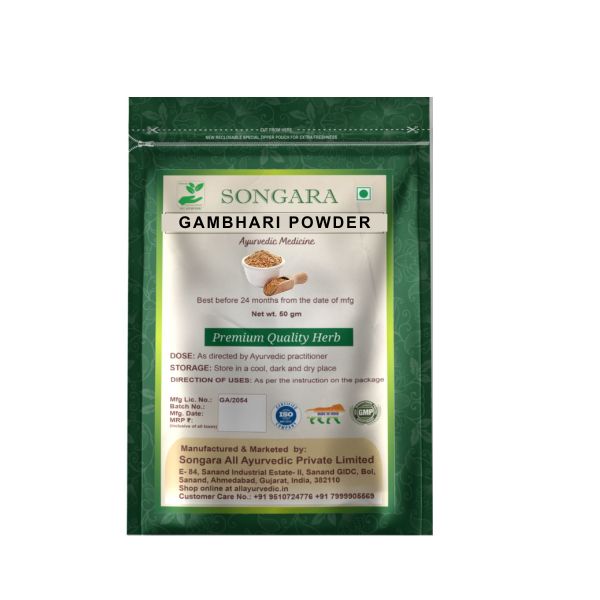
Gambhari Powder (Gmelina arborea) – The Ayurvedic Wellness Herb
Gambhari Powder (Gmelina arborea) – The Ayurvedic Wellness Herb
Regular price
Rs. 35.00
Regular price
Rs. 39.00
Sale price
Rs. 35.00
Taxes included.
Shipping calculated at checkout.
No reviews
Quantity
Couldn't load pickup availability
1. Synonyms (नामानि / Nāmanī)
Sanskrit Names:
गम्भारी (Gambhārī), भद्रपर्णी (Bhadraparṇī), श्रीपर्णी (Śrīparṇī), मधुपर्णिका (Madhuparnikā), काश्मरी (Kāśmarī), काश्मीरी (Kāśmīrī), हीरा (Hīrā), कृष्णवृन्ता (Kṛṣṇavṛntā), मधुरसा (Madhurasā), महाकुसुमिका (Mahākusumikā), पीतरोहिणी (Pītarohiṇī)
Etymological meaning:
- गम्भारी — “गमे रससत्वात् भारोऽस्या” → Possessing richness or heaviness of essence and moisture.
- काश्मरी — “काशते इति काश्मरी” → Having shining and glistening foliage.
- मधुपर्णी — “मधु इव पर्णान्यस्याः” → Having sweet, attractive leaves.
- श्रीपर्णी — Having beautiful leaves that denote prosperity.
- भद्रपर्णी — Whose leaves are beneficial and auspicious.
2. Regional Names (प्रादेशिक नामानि / Prādeśika Nāmanī)
| Language | Regional Name |
|---|---|
| Hindi | Gambhārī (गम्भारी), Sewana (सेवन), Khambhārī (खम्भारी) |
| Bengali | Gamārī (গমারি), Gambara |
| Marathi | Śivana (शिवना) |
| Gujarati | Gambharā, Khambharā |
| Oriya | Gambārī |
| Tamil | Gumudu Teku (गुमुडु टेकु), Teggummadu |
| Telugu | Gumāra Teku (गुमार टेक), Pedda Gomaru |
| Kannada | Kāsmiri (ಕಾಸ್ಮಿರಿ), Sivanī |
| Malayalam | Kumbili |
| Nepali | Gambara |
| Assamese | Gomari |
| Tribal (Santal, Gond) | Kāsamara, Kurase |
Botanical name: Gmelina arborea Roxb.
Family: Verbenaceae
3. Botanical Description (वनस्पति-विवरणम् / Vanaspati Vivarṇam)
- Habit: A moderate to large deciduous tree, attaining up to 18–20 meters (≈ 60 ft).
- Bark: Grey, smooth, exfoliating in scales.
- Leaves: 10–20 × 7.5–15 cm, broadly ovate, acuminate with rounded or heart-shaped base; opposite; petiole 5–7.5 cm long.
- Flowers: Yellow, tinged with brown, densely tomentose, borne in terminal or axillary panicles; Corolla 5-lobed.
- Fruit: A drupe, 2.5 cm, ovoid or obovate, fleshy, smooth, yellow when ripe; mildly aromatic.
- Flowering: March–April
- Fruiting: May–June
- Habitat: Found in sub-Himalayan tracts from Punjab to Assam, and throughout Central & South India; also in the Andaman Islands.
4. Chemical Constituents (रासायनिक संघटकाः / Rāsāyanika Saṅghatakāḥ)
Isolated Compounds:
- Sterols: β-Sitosterol, Campesterol, Stigmasterol, Stigmastanol
- Alcohols & Esters: Ceryl alcohol, Hentriacontanol-1, Cluytyl ferulate
- Phenolics & Lignans: Gmelinol, Isoarboreol, Arboreol, Epieudesmin, Gummadiol, Gmelanone, Gmelofuran
- Flavonoids: Apigenin, Luteolin, Quercetin
- Fatty Acids (Seed oil): Oleic, Linoleic, Palmitic, Myristic, Stearic, Arachidic, Lauric acids
- Carbohydrates: Arabinose, Galactose, Glucose, Rhamnose, Xylose (heartwood polysaccharides)
- Others: Betulin, Methyl-trans-p-methoxycinnamate, Benzoic acid, Octacosanol
- Biological Activity: Leaves exhibit antibiotic activity against E. coli and Staphylococcus aureus.
Nutritional/Other Components:
The fruit contains traces of butyric and tartaric acids and a saccharine resinous substance. Seeds yield a semi-drying fatty oil with greenish-yellow hue.
5. Properties and Therapeutic Uses (गुणाः तथा चिकित्सोपयोगाः / Guṇāḥ tathā Cikitsopayogāḥ)
Ayurvedic Properties:
| Property | Description |
|---|---|
| Rasa (Taste) | Madhura (Sweet), Tikta (Bitter), Tuvra (Slightly Pungent) |
| Guna (Quality) | Guru (Heavy), Snigdha (Unctuous) |
| Virya (Potency) | Ushna (Hot) — for bark & root; Shīta (Cold) — for fruit |
| Vipaka (Post-digestive effect) | Madhura (Sweet) |
| Karma (Action) | Dīpana (Digestive), Pācana (Carminative), Medhya (Brain tonic), Bhedanī (Laxative), Br̥ṃhaṇa (Nourishing), Rasāyana (Rejuvenative), Keśya (Promotes hair growth) |
Therapeutic Uses:
- Fruits:
- Br̥ṃhaṇa (body-building) and Vṛṣya (aphrodisiac)
- Rasāyana (rejuvenative) and Keśya (promotes hair growth)
- Useful in Vāta-Pitta disorders, excessive thirst, anemia (raktakṣaya), consumption (kṣaya), urinary retention (mūtravibandha)
- Acts as a hemostatic (Raktasāṅgrāhika) and Raktapitta-praśamana (alleviates bleeding disorders).
- Roots:
- One of the ten roots of the famous Daśamūla group.
- Decoction with licorice, honey, and sugar promotes lactation (stanya-janana).
- Leaves:
- Juice is used as demulcent in gonorrhea and cough.
- Paste with Apāmārga root and Salmalī-kaṇḍa in milk helps in hyperacidity.
- Stem Bark:
- Used traditionally for fermentation of toddy.
- Timber is durable and water-resistant; used in musical instruments and construction.
6. Dose (मात्रा / Mātrā)
Root powder 3–6 g
Fruit powder 1–3 g
Summary Table
| Category | Details |
|---|---|
| Botanical Name | Gmelina arborea Roxb. |
| Family | Verbenaceae |
| Ayurvedic Name | Gambhārī / Kaśmarī |
| Useful Parts | Fruit, Root, Leaves, Bark |
| Main Actions | Rasāyana, Medhya, Keśya, Br̥ṃhaṇa, Dīpana |
| Major Uses | Fever, Thirst, Anemia, Vāta-Pitta disorders, Piles, Bleeding, Weakness, Cough, Lactation |
| Modern Activity | Antibacterial, Hepatoprotective, Anti-inflammatory, Demulcent |
Ref: Bhavaprakash Nighantu
Materials
Materials
Shipping & Returns
Shipping & Returns
Dimensions
Dimensions
Care Instructions
Care Instructions
Share
No reviews