1
/
of
5
Songara All Ayurvedic
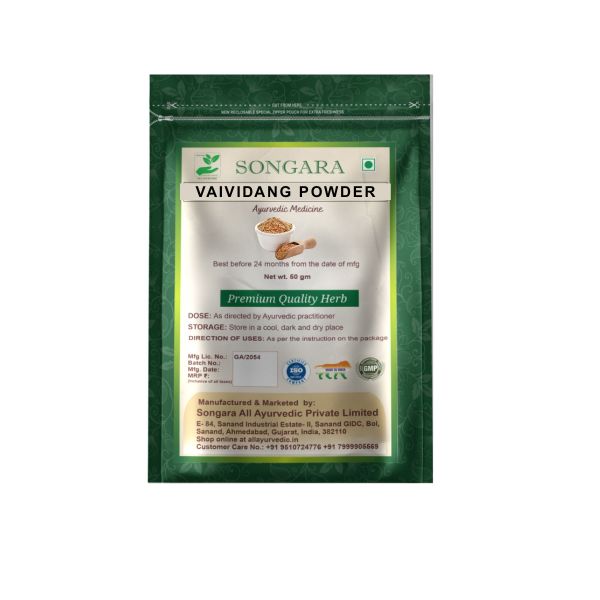
Vaividang Powder (Embelia ribes) – The Ayurvedic Detox Herb
Vaividang Powder (Embelia ribes) – The Ayurvedic Detox Herb
سعر عادي
Rs. 180.00
سعر عادي
Rs. 198.00
سعر البيع
Rs. 180.00
Taxes included.
يتم احتساب الشحن عند الخروج.
No reviews
Quantity
تعذر تحميل مدى توفر الطلب
🌿 Vaividang (Vidanga) / Embelia ribes Burm.f.
Family: Myrsinaceae
Part Used: Dried Fruit (Seeds)
1. Synonyms (पर्याय / समानार्थक नाम)
Sanskrit Synonyms:
- विडङ्गम् (Vidangam): ‘विडति भिनत्ति इति’ — That which removes digestive obstruction, pain, and worms.
- कृमिघ्नः (Krumighna): Destroyer of worms and parasites.
- जन्तुनाशनः (Jantunāśanaḥ): Annihilator of intestinal worms.
- तण्डुलः (Tandulah): Its seeds resemble rice grains.
- वेल्लम् (Vellam): Having drooping branches.
- अमोघा (Amoghā): Possesses definite, infallible anthelmintic action.
- चित्रतण्डुलः (Chitra-Tandulah): Having beautifully mottled seeds.
- English Names: False Black Pepper, Embelia, Vidang
- Botanical Name: Embelia ribes Burm.f.
2. Regional Names
| Language | Regional Name |
|---|---|
| Hindi | बायविडंग (Bāyavidang), बाभिरंग (Bābhirang) |
| Bengali | विरंग (Virang) |
| Marathi | वावडिंग (Vāvading) |
| Gujarati | वायवडंग (Vayavadang) |
| Kannada | वायुविडंग (Vayuvidanga), वायविलंग (Vayavilang) |
| Telugu | वायुविडंघमु (Vayuvidanghamu) |
| Tamil | Vayavidangam |
| Malayalam | Vijhala |
| English | False Black Pepper |
| Sanskrit | Vidangam |
3. Botanical Description
- Habit: Large scandent (climbing) shrub, commonly found in the hilly regions throughout India.
- Leaves: Elliptic-oblong, leathery, smooth, entire, shiny above, paler beneath; petiole often glandular.
- Flowers: Small, greenish-yellow to white; borne on pedicels longer than the flowers.
- Fruits: Round berries, black when ripe, wrinkled when dry; aromatic, pungent taste.
- Seeds: Solitary, globose, reddish-brown to black.
- Flowering: August–September
- Fruiting: October–December
- Habitat: Western Ghats, Himalayas, Bengal, Assam, and parts of Madhya Pradesh.
4. Chemical Constituents
Major Active Compounds:
- Embelin: 2,5-dihydroxy-3-lauryl-p-benzoquinone (main anthelmintic principle, 2.5–3.1%)
- Christembine (Alkaloid)
- Homoemblin and Homorapanone
- Vilangine: Methylene-bis-(2,5-dihydroxy-4-undecyl-3,6-benzoquinone)
- Quercitol (1.0%)
- Fatty oil, Resinoids, Tannins, and Trace Volatile Oils
Pharmacological Activities (Modern Studies):
- Anthelmintic (especially against Ascaris lumbricoides)
- Antibacterial (active against Staphylococcus aureus and E. coli)
- Carminative, Antioxidant, Anti-inflammatory
5. Properties and Therapeutic Uses (गुण, कर्म, उपयोग)
Ayurvedic Properties
| Rasa (Taste) | Katu (Pungent) |
|---|---|
| Guna (Qualities) | Laghu (Light), Ruksha (Dry), Tikshna (Sharp) |
| Virya (Potency) | Ushna (Hot) |
| Vipaka (Post-digestive Effect) | Katu |
| Doshic Action | Pacifies Kapha and Vata doshas |
Classical References & Mentions:
- Charaka Samhita: Listed under Krumighna Mahakashaya, Trptighna, Kusthaghna, Sirovirecana Dravya.
- Sushruta Samhita: Included in Surasadi Gana and Pippalyadi Gana.
- Described as: “Krumighna-shreshtha” — the best among worm-destroying herbs.
Pharmacological & Therapeutic Actions (Karma):
- Krumighna: Destroys intestinal worms
- Deepana: Stimulates digestive fire
- Pachana: Aids digestion
- Rasayana: Rejuvenative and restorative
- Grahi: Absorbent, reduces excessive discharge
- Lekhana: Reduces excess fat and toxins
- Medhya: Improves intellect and mental clarity
Therapeutic Uses:
- Intestinal Worms (Krumiroga):
- Most effective against roundworms (Ascaris lumbricoides).
- Given with honey or curd, followed by a mild purgative after 4 hours.
- Digestive Disorders:
- Relieves abdominal pain, flatulence, indigestion, and distension.
- Skin Diseases (Kustha):
- Used internally and externally in various chronic skin disorders.
- Childhood Disorders:
- Used in pediatric emaciation, indigestion, and distension (boiled with milk).
- Lymphatic Disorders / Scrofula:
- Given with Guggulu, Manahsila, Shankha bhasma, and honey.
- Respiratory Ailments:
- Beneficial in dyspnea, cough, and catarrh (used as nasal medication with milk).
- Neurological Conditions:
- Used in hemiplegia, convulsions, epilepsy with Rasona and milk.
- Urinary Disorders (Mutrakriccha):
- Used in turbidity of urine and cystitis (fresh fruits recommended).
- Toxic Conditions:
- Helpful in scorpion sting and snake bite (as supportive herbal aid).
- Rejuvenative Therapy (Rasayana):
- Mentioned in Sarvopaghata-Samaniya Adhyaya of Sushruta Samhita.
- Promotes intellect, strength, and vitality.
6. Doses and Administration
Form Dose Anupana (Vehicle)
Powder (Churna) 4–16 g Honey, Curd, or Milk
- Avoid in excessive Pitta conditions.
- Prolonged use should be under Ayurvedic supervision.
- Not to be taken in pregnancy without advice.
Summary Table
| Aspect | Details |
|---|---|
| Botanical Name | Embelia ribes Burm.f. |
| Family | Myrsinaceae |
| Part Used | Dried Fruit |
| Active Constituents | Embelin, Christembine, Vilangine, Quercitol |
| Actions | Anthelmintic, Carminative, Digestive, Rasayana |
| Primary Indications | Worm infestation, Indigestion, Skin disorders, Piles |
| Taste (Rasa) | Katu (Pungent) |
| Potency (Virya) | Ushna (Hot) |
| Effect on Dosha | Pacifies Kapha & Vata |
| Dose | 4–16 g of powder with honey or milk |
Ref: Bhavaprakash Nighantu
مواد
مواد
الشحن والاسترجاع
الشحن والاسترجاع
أبعاد
أبعاد
تعليمات العناية
تعليمات العناية
يشارك
No reviews