1
/
of
5
Songara All Ayurvedic
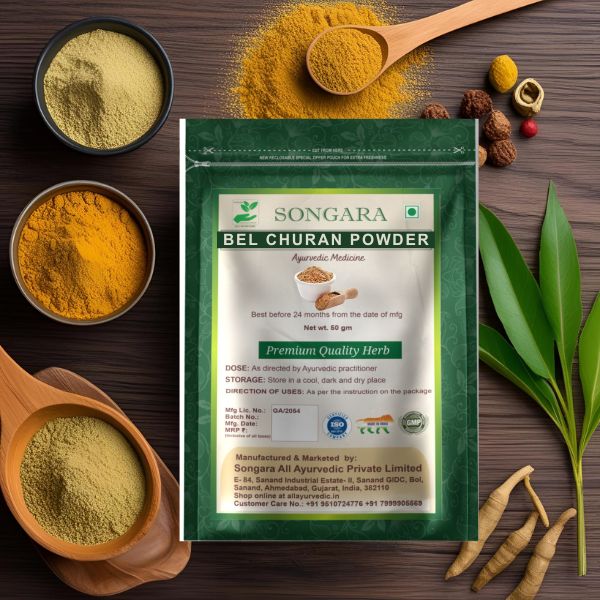
Songara Bel Churna Aegle marmelos & Achyranthes aspera – The Ayurvedic Pure Herb
Songara Bel Churna Aegle marmelos & Achyranthes aspera – The Ayurvedic Pure Herb
سعر عادي
Rs. 179.00
سعر عادي
Rs. 189.00
سعر البيع
Rs. 179.00
Taxes included.
يتم احتساب الشحن عند الخروج.
No reviews
Quantity
تعذر تحميل مدى توفر الطلب
Bel Churna (Bilva Churna)
Botanical Name: Aegle marmelos Correa ex Roxb.
Family: Rutaceae
English Name: Bael Tree
Part Used: Unripe Fruit (Pulp)
Ayurvedic Form: Powder (Churna)
1. Synonyms (पर्याय / समानार्थक नाम)
- Sanskrit: Bilvah (बिल्वः), Śāṇḍilyah (शाण्डिल्यः), Śailūṣah (शैलूषः), Mālūrah (मालूरः), Śrīphalah (श्रीफलः)
- Etymological Meanings:
- Bilvaḥ – “Bilati Bhinatti Bilvaḥ” – It breaks or pacifies Vāta and Kapha doṣas.
- Śāṇḍilyah – Auspicious, related to the sage Śāṇḍilya, symbolizing sacredness.
- Śailūṣah – Having various forms and morphological variations.
- Mālūrah – “Removes impurities and brings fortune.”
- Śrīphalaḥ – “The fruit of Goddess Lakṣmī” – brings prosperity and auspiciousness.
2. Regional Names (प्रादेशिक नाम)
| Language | Name |
|---|---|
| Hindi | बेल (Bel), सिफल (Siphala), सिरिफल (Siriphala) |
| Bengali / Assamese / Marathi / Gujarati | बेल (Bela / Bil / Vilva) |
| Sindhi | Bila, Katorī |
| Telugu | Maredu, Maluramu, Bilva Pandu |
| Tamil | Vilvam |
| Kannada | Bilapatri, Belapatri |
| Malayalam | Kuvalap-pajjham |
| Korku / Gondi | Bela, Korvalam |
| English | Bael, Bengal Quince, Wood Apple |
3. Botanical Description (वनस्पति विवरण)
- Type: Medium-sized, aromatic, deciduous tree.
- Height: 6–8 meters, with strong axillary thorns (~2.5 cm long).
- Leaves: 3-foliate, alternate, aromatic; leaflets ovate-lanceolate and pointed.
- Flowers: Greenish-white, fragrant, about 3 cm across; blooming in March–April.
- Fruit: Hard, globose berry (5–17.5 cm in diameter), grey or yellow rind with orange-colored pulp inside.
- Seeds: Numerous, embedded in a sticky mucilage with transparent gum-like texture.
- Habitat: Found throughout India, especially sub-Himalayan regions, central and southern India; often cultivated near Shiva temples.
4. Chemical Constituents (रासायनिक संघटक)
Major Active Compounds:
- Coumarins: Marmin, Marmelosin, Imperatorin, Alloimperatorin, Marmelide.
- Alkaloids: Dictamnine, Skimmianine.
- Flavonoids & Glycosides: Aurapten, Isoimperatorin, Aegeline, Anthocyanins.
- Tannins & Vitamins: Vitamin C, Carotene, and Polyphenols.
- Essential Oils: Caryophyllene, Citral, Limonene, Eugenol, Methyleugenol.
- Others: β-Sitosterol, Psoralen, Fatty acids (Linoleic, Palmitic, Oleic, Stearic).
Pharmacological Activity:
- Antimicrobial, Anti-inflammatory, Antioxidant, Anti-diabetic, and Gastroprotective.
- Essential oil shows broad-spectrum antifungal properties (comparable to 0.5% Hamycin).
5. Properties & Therapeutic Uses (गुण एवं चिकित्सीय उपयोग)
Rasa (Taste): Kashaya (Astringent), Tikta (Bitter)
Guna (Quality): Laghu (Light), Rūkṣa (Dry)
Virya (Potency): Uṣṇa (Hot)
Vipāka (Post-digestive effect): Kaṭu (Pungent)
Doṣa Karma: Pacifies Vāta and Kapha, but may increase Pitta.
Ayurvedic Actions (क्रियाएँ):
- Grahi (Absorbent)
- Deepana (Appetizer)
- Pachana (Digestive)
- Hṛdya (Cardiac tonic)
- Amahara (Detoxifying)
- Vata-Kapha Shamaka (Balances Vata and Kapha doshas)
Medicinal Parts Used:
- Unripe Fruit Pulp (Bilva Majja): Astringent, digestive, anti-diarrheal.
- Ripe Fruit: Mild laxative, cooling, aromatic.
- Root Bark: Anti-emetic, nervine tonic (part of Dashamoola).
- Leaves: Vata-pacifying, sacred in worship, mild laxative.
Traditional & Therapeutic Uses:
| Indication | Form / Application | Action |
|---|---|---|
| Diarrhoea, Dysentery | Unripe fruit powder | Astringent, stops loose motion |
| Digestive disorders, IBS (Sangrahika) | Powder with warm water | Improves digestion |
| Loss of appetite | Decoction of unripe fruit | Stimulates appetite |
| Diabetes mellitus | Powder 10–20 g daily | Reduces sugar levels |
| Constipation (Chronic) | Ripe fruit pulp | Mild laxative |
| Inflammation, Fever | Root bark decoction | Anti-inflammatory |
| Mental disorders, Nervousness | Root bark or oil | Calming & neurotonic |
| Ulcers, Mucous imbalance | Fruit pulp | Soothes mucous membrane |
Modern Therapeutic Observations:
- Marmin exhibits anti-inflammatory effect (Carrageenan-induced rat inflammation model).
- Aurapten shows calcium-channel blocking (cardiac calming) effects comparable to Verapamil.
- Alcoholic extracts display anti-allergic and antioxidant properties.
6. Doses (मात्रा)
Churna (Powder)
2–8 g twice a day
Warm water or honey
7. Ayurvedic Reference & Authority Texts
- Charaka Samhita: Arsoghna, Sothaghna, Asthapanopaga, Anuvāsanopaga Mahākāśāya.
- Sushruta Samhita: Varunādi Gana, Ambasthādi Gana, Daśamūla Gana.
- Bhāvaprakāśa: Mentioned as best herb for Sangrahika (IBS-like disorders).
8. Summary Table
| Property | Detail |
|---|---|
| Botanical Name | Aegle marmelos Correa ex Roxb. |
| Family | Rutaceae |
| Part Used | Unripe Fruit |
| Rasa (Taste) | Tikta, Kashaya |
| Guna (Quality) | Laghu, Rūkṣa |
| Virya (Potency) | Uṣṇa |
| Vipaka (Post-digestive) | Kaṭu |
| Doṣa Karma | Vāta-Kapha Shāmaka |
| Key Benefits | Digestive, Antidiarrheal, Strength-promoting, Cardiac tonic, Memory enhancer |
| Dose | 2–8 g powder daily |
| Modern Actions | Antioxidant, Antimicrobial, Anti-inflammatory, Antidiabetic |
مواد
مواد
الشحن والاسترجاع
الشحن والاسترجاع
أبعاد
أبعاد
تعليمات العناية
تعليمات العناية
يشارك
No reviews