1
/
of
4
Songara All Ayurvedic
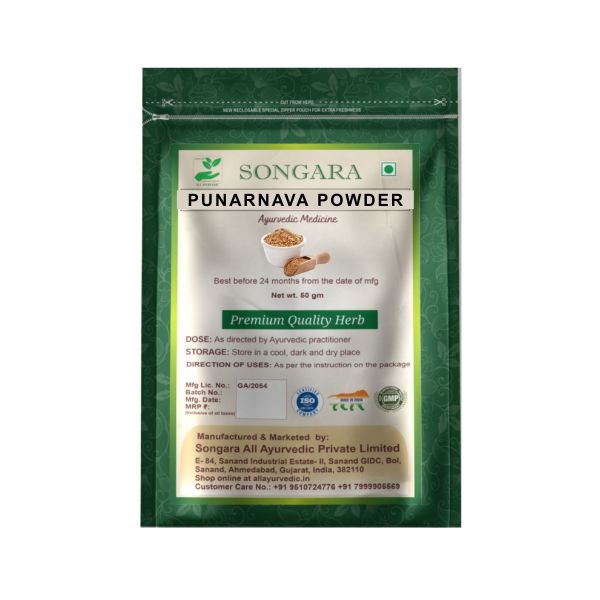
Punarnava Powder (Boerhaavia diffusa) – The Ayurvedic Rejuvenator
Punarnava Powder (Boerhaavia diffusa) – The Ayurvedic Rejuvenator
سعر عادي
Rs. 61.00
سعر عادي
Rs. 67.00
سعر البيع
Rs. 61.00
Taxes included.
يتم احتساب الشحن عند الخروج.
No reviews
Quantity
تعذر تحميل مدى توفر الطلب
🌿 Punarnavā (Boerhavia diffusa Linn.)
Family: Nyctaginaceae
English Name: Spreading Hogweed
Sanskrit Synonyms: Punarnavā, Śvetamūlā, Raktapunarnavā, Sothaghni, Dirghapatrikā
1. Synonyms (पर्यायनामानि)
| Sanskrit Name | Etymological Meaning | Significance |
|---|---|---|
| Punarnavā (पुनर्नवा) | “Punah Nava” – becomes new again | Regenerates during rainy season and rejuvenates body tissues |
| Śvetamūlā (श्वेतमूला) | White-rooted variety | Denotes white root form |
| Raktapunarnavā (रक्तपुनर्नवा) | Red-flowered variety | Distinct type with reddish flowers |
| Sothaghni (शोथघ्नी) | “Destroyer of swelling” | Used for oedema and inflammation |
| Dirghapatrikā (दीर्घपत्रिका) | “Having long leaves” | Morphological description |
| Silātikā / Śivātikā (शिलाटिका) | “Spreading plant” | Creeping habit of growth |
| Kṣudra Varṣābhū (क्षुद्रवर्षाभू) | “Small rain herb” | Regrows with monsoon rains |
| Varṣaketuh (वर्षकेतुः) | “Flag of rainy season” | Symbol of seasonal regeneration |
| Kathillakaḥ (कठिल्लकः) | “Remover of distress” | Symbolically removes sorrows by curing diseases |
2. Regional Names
| Language | Common Name |
|---|---|
| Hindi | Punarnavā, Lāl Punarnavā (Red variety), Śveta Punarnavā (White variety), Sānth, Gadahapurnā |
| Bengali | Punarnabā |
| Marathi | Punarnavā, Vasu, Ghentuli |
| Gujarati | Dhōlī Sāturdī, Moto Sātodo, Visakhaparo, Nano Vasedo, Rāto Vasedo |
| Telugu | Atika Mamidi |
| Punjabi | Khattana |
| Tamil | Mukaraṭṭai |
| Malayalam | Tajhutama |
| English | Spreading Hogweed |
3. Botanical Description
- Botanical Name: Boerhavia diffusa Linn.
- Family: Nyctaginaceae
- Habitat: Found throughout India in wastelands and cultivated regions.
- Nature: Perennial, diffusely branched herb.
- Stem: Prostrate, 30–60 cm long, slender, often purplish.
- Leaves: Opposite, unequal in pairs at each node; thick, ovate to oblong, 1.2–3 cm long; upper surface green, underside white, with undulate pinkish margins.
- Flowers: Minute, pink or white, short-stalked, arranged in small clusters.
- Fruit: Small (3 mm), clavate, glandular, ribbed, one-seeded, sticky when ripe.
- Flowering/Fruiting: Common during monsoon and post-monsoon seasons.
Varieties Identified:
- Śveta Punarnavā – Boerhavia diffusa Linn. (White flowers)
- Rakta Punarnavā – Boerhavia repanda Willd. (Red flowers)
- Nīla Punarnavā – (Dark green leaves; rare variety)
(Other regional substitutes include Trianthema portulacastrum and Boerhavia erecta in South India.)
4. Chemical Constituents
- Alkaloids: Punarnavine-1, Punarnavine-2
- Glycosides: Punarnavoside (antifibrinolytic agent)
- Sterols: β-sitosterol
- Flavonoids: Boeravinones A, B, C; 5,7-dihydroxy-3’,4’-dimethoxy-6,8-dimethyl flavone
- Acids: Ursolic acid, Myristic acid, Oxalic acid
- Other Compounds: Hentriacontane, Myricyl alcohol, D-glucose, Triacontanol, Hypoxanthin-9-L-arabinofuranoside
- Proteins and Carbohydrates: Present in roots and leaves
Pharmacological Findings:
- Diuretic
- Anti-inflammatory
- Antibacterial (effective against Staphylococcus aureus and E. coli)
- Cardiotonic
- Hepatoprotective
- Anti-fibrinolytic
5. Properties and Therapeutic Uses (गुण, कर्म, उपयोग)
| Property | Sanskrit Term | Description |
|---|---|---|
| Rasa (Taste) | Madhura (Sweet), Tikta (Bitter), Kaṭu (Pungent) | |
| Guna (Quality) | Laghu (Light), Rūkṣa (Dry) | |
| Virya (Potency) | Uṣṇa (Hot) | |
| Vipāka (Post-digestive effect) | Kaṭu (Pungent) | |
| Doṣa Karma | Pacifies Kapha and Pitta; mildly increases Vāta | |
| Main Action | Śothaghni (anti-swelling), Mutrala (diuretic), Jvaraghni, Rasāyana |
Therapeutic Uses:
- Diuretic & Anti-inflammatory: Used in dropsy, oedema, ascites, and nephritis.
- Hepatoprotective: Helpful in jaundice, ascites, and hepatic disorders.
- Cardiotonic: Supports heart function, used in cardiac swelling and dyspnoea.
- Rasāyana: Promotes rejuvenation and tissue regeneration.
- Respiratory Disorders: Useful in bronchitis, cough, and asthma (with Vaca and Zingiber).
- Skin Disorders: Beneficial in chronic ulcers, skin eruptions, and bites (scorpion/snake).
- Eye Diseases: Root paste with honey used in conjunctivitis.
- Gastrointestinal Disorders: Improves appetite, digestion, and relieves constipation.
- Renal Disorders: Increases urine output; beneficial in nephrotic syndrome and proteinuria.
- Arthritis: Fruit decoction helps relieve joint pain.
6. Dosage (मात्रा)
Powder (Churn)
3–10 g
With warm water or milk
7. Classical References
- Caraka Samhita: Mentioned in Svedopaga, Anuvasanopaga, Kasahara, and Vayaḥsthapana Mahākāṣāyas.
- Suśruta Samhita: Listed in Vidārigandhādi Gana.
- Rāja Nighaṇṭu: Three types described – Śveta, Rakta, and Nīla Punarnavā.
8. Summary
Punarnavā is a powerful rejuvenative (Rasāyana) and diuretic herb with proven benefits in renal, hepatic, and inflammatory disorders.
Its dual action—removing excess fluid (Mutrala) while revitalizing body tissues (Rasāyana)—makes it one of the most versatile herbs in Ayurveda.
Ref: Bhavaprakash Nighantu
مواد
مواد
الشحن والاسترجاع
الشحن والاسترجاع
أبعاد
أبعاد
تعليمات العناية
تعليمات العناية
يشارك
No reviews