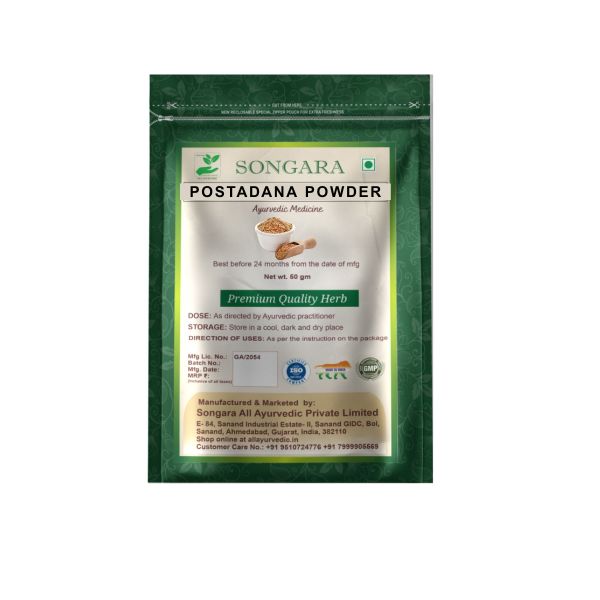
Songara All Ayurvedic
Postadana Powder (Seeds) – The Ayurvedic Wellness Herb
Postadana Powder (Seeds) – The Ayurvedic Wellness Herb
تعذر تحميل مدى توفر الطلب
🌿 Poppy Seeds (Postadana)
Part Used: Seeds
Family: Papaveraceae
1. Synonyms
- Sanskrit: अहिफेनकम् (Ahiphenakam), आफूकम् (Aphūkam), खसखस (Khasakhasa)
- English: Poppy seed
- Arabic: Aphayun
- Persian: Afiyun
- Hindi: Afim Dane (अफीम दाने)
- Etymology:
-
Ahi (सर्प) + Phena (फेन) — “Foam or secretion like snake venom” indicating its potent and poisonous nature.
2. Regional Names
| Language | Name |
|---|---|
| Hindi | अफीम (Afim) |
| Bengali | अफीम (Aphima) |
| Marathi | अफू (Aphu) |
| Malayalam | അലാന (Alana) |
| Gujarati | અફીણ (Aphina) |
| Telugu | అభిని (Abhini) |
| Kannada | ಅಫಿನಿ (Aphini) |
| Tamil | அபினி (Abini) |
| Oriya | अफीम (Aphima) |
| Arabic | أفیون (Aphayun) |
| English | Opium |
3. Botanical Description
Papaver somniferum Linn. is an erect, annual herb 60–120 cm high, rarely branched, usually glaucous (bluish-green).
- Leaves: Ovate-oblong, amplexicaule (clasping the stem), serrate or lobed, bluish-green.
- Flowers: Large, showy, white or bluish with a purple base; occasionally red or variegated.
- Fruit (Capsule): Globose, smooth, 2–5 cm in diameter, crowned with radiating stigmatic rays.
- Seeds: Tiny, round, white, black, or bluish depending on the variety.
- Latex: The unripe capsules exude a milky latex when incised, which coagulates to form raw opium.
- Habitat: Cultivated widely in northern India—Uttar Pradesh, Madhya Pradesh, Rajasthan, and parts of Bihar.
- Flowering & Fruiting Season: November to April.
4. Chemical Constituents
Poppy seeds are chemically rich, containing nutrients, fatty acids, amino acids, tocopherols, minerals, and phytochemicals.
🧪 Macronutrient Composition
Proteins
- Protein content: 21.5–23.5%
- Major amino acid: Glutamic acid (36 mg/g in seeds; 59 mg/g in poppy cake)
Fats (Oil Content)
- Oil content: 46.2–49.4%
- Rich in polyunsaturated fatty acids (PUFAs)
Dietary Fiber
- High fiber content, especially in partially defatted poppy cake (≈38%)
🧬 Fatty Acid Profile
Poppy seed oil is dominated by unsaturated fatty acids, especially:
|
Fatty Acid |
Approx. % |
Notes |
|
Linoleic acid (Omega‑6) |
>50% |
Predominant PUFA [1] |
|
Oleic acid (Omega‑9) |
Moderate |
Contributes to stability |
|
Palmitic & Stearic acids |
Minor |
Saturated fatty acids |
The oil has low oxidative stability due to high PUFA content. [1]
🧴 Vitamins & Antioxidants
Tocopherols (Vitamin E compounds)
- α‑tocopherol: >21 mg/kg
- γ‑tocopherol: >25 mg/kg [1]
These contribute to antioxidant activity.
🌱 Phytochemicals & Bioactive Compounds
Poppy seeds contain:
- Phenolic compounds
- Flavonoids
- Antioxidants
- Polyunsaturated fatty acids
- Trace alkaloids (very low compared to pods/straw)
These compounds contribute to potential nutraceutical and functional food applications. [2]
⚗️Alkaloid Content
- Seeds contain very low levels of opiate alkaloids compared to pods and straw.
- Levels may vary depending on harvesting and washing. [3]
🧂Minerals
Although not detailed in the above sources, poppy seeds are known to contain:
- Calcium
- Magnesium
- Phosphorus
- Iron
- Zinc
5. Properties and Therapeutic Uses
In Ayurveda, poppy seeds (Beeja) are described as Madhura–Kashaya in Rasa, Guru in Guna, Sheeta in Veerya, and Madhura in Vipaka, with actions such as Balya, Vrishya, Nidrajanana, and Shoolaprashamana.
🍯 1. Rasa (Taste)
|
Property |
Description |
|
Madhura (Sweet) |
Nourishing, strengthening |
|
Kashaya (Astringent) |
Absorptive, stabilizing |
📌 Source: Ayurvedic Rasa‑Panchaka of Ahiphena Beej (Seeds) lists Madhura + Kashaya Rasa. [4]
⚖️ 2. Guna (Qualities)
|
Guna |
Effect |
|
Guru (Heavy) |
Increases nourishment, slows digestion |
📌 Source: Ahiphena Beej is described as Guru in Guna. [4]
❄️ 3. Veerya (Potency)
|
Veerya |
Effect |
|
Sheeta (Cold potency) |
Cooling, Pitta‑pacifying, stabilizing |
📌 Source: Seeds (Beeja) are specifically stated to have Sheeta Veerya. [4]
🍬 4. Vipaka (Post‑digestive effect)
|
Vipaka |
Effect |
|
Madhura Vipaka |
Builds tissues (Dhatu‑vardhaka), supports Ojas |
📌 Source: Ahiphena Beej undergoes Madhura Vipaka. [4]
🌿 5. Ayurvedic Actions (Karma) of Poppy Seeds
According to classical Ayurvedic descriptions:
Primary Actions
- Balya – Strength‑promoting
- Vrishya – Aphrodisiac
- Nidrajanana – Promotes sleep
- Shoolaprashamana – Relieves colic/pain
- Grahi – Absorptive, useful in loose stools
- Dhatu‑vardhaka – Nourishes tissues
📌 Source: Karma of Ahiphena Beej includes Balya, Vrishya, and Dhatu‑vardhaka. [4]
⚖️ 6. Effect on Doshas
|
Dosha |
Effect |
|
Vata ↓ |
Due to Madhura Rasa + Guru Guna + Sheeta Veerya |
|
Pitta ↓ |
Due to Sheeta Veerya |
|
Kapha ↑ |
Due to Madhura Rasa + Guru Guna |
📌 Source: Seeds are described as Pittahara and Kapha‑increasing. [4]
Classical References:
- Mentioned as Ahiphenakam or Aphūkam in Ayurvedic Nighantus.
- Noted in later texts after introduction during the Mohammedan period.
- Rarely used traditionally due to strong narcotic effects.
Therapeutic Uses:
In Ayurveda, poppy seeds are primarily described as Balya, Vrishya, Grahi, and mildly Nidrajanana, with specific uses in gastrointestinal, neurological, and dermatological conditions.
These uses come from classical references compiled in modern Ayurvedic monographs.
🩺 1. Balya (Strength‑Promoting)
- Seeds are Dhātu‑vardhaka (tissue‑nourishing).
- Used in weakness, convalescence, and general debility.
Reference: Ahiphena Beej is described as Balya and Dhātu‑vardhaka. [4]
❤️ 2. Vrishya (Aphrodisiac)
- Enhances reproductive strength and supports Shukra Dhatu.
- Used in male reproductive weakness.
Reference: Seeds are listed as Vrishya. [4]
😴 3. Nidrajanana (Sleep‑Promoting)
- Mildly sedative due to Sheeta Veerya + Madhura Vipaka + trace alkaloids.
- Traditionally used for insomnia and disturbed sleep.
Reference: Ahiphena Beej is Nidrajanana. [4]
🧘♂️ 4. Shoolaprashamana (Pain‑Relieving)
- Helpful in colicky pain, abdominal cramps, and Vata‑related pain.
- Seeds are gentler than latex and used in formulations for mild pain.
Reference: Listed under Shoolaprashamana. [4]
🩹 5. Grahi (Absorptive / Anti‑diarrheal)
- Useful in Atisara (diarrhea) and loose stools.
- Often combined with honey or other Grahi herbs.
Reference: Seeds are Grahi; Ahiphena used in Atisara formulations. [4]
🌬️ 6. Respiratory Uses (Kasa, Shwasa)
- Used in classical formulations for cough and fever (Kasa–Jvara).
- Included in Yavanadi Kwatha and Khaskhas Niryuha.
Reference: Bhava Prakasha Chikitsa Sthana 1/383; Siddha Bhaishajya Manimala 4/325–326. [4]
🧴 7. Dermatological Uses
-
Seed paste with milk is applied for dandruff (Darunaka).
Reference: Sharangadhara Samhita 3.11.19. [4]
🔥 8. Anti‑inflammatory / Swedajanana
- Mildly reduces swelling and stiffness when used externally.
Reference: Listed as Sweda‑janana and used in Sandhi‑Shotha. [4]
🧠 9. Neurological Uses
- Used in Apsmara, Dhanustambha, Kampavata, and Vata‑dominant neurological disorders (in compound formulations).
Reference: Internal indications include Apsmara, Dhanustambha, Kampavata. [4]
🩸 10. Rakta‑stambhaka (Hemostatic)
- Helps reduce minor bleeding tendencies due to astringent (Kashaya) Rasa.
Reference: Listed as Rakta‑stambhaka. [4]
6. Doses and Administration
-
Seeds or Seed Powder (Churna): 3- 6 gm.
Summary: In Ayurveda, poppy seeds (Beeja) are used in small, food‑level therapeutic doses, typically 3–6 grams per day, depending on the condition, anupāna, and formulation. These doses apply to seeds only, not latex (Ahiphena), which has strict classical regulation.
📚 Primary References
- Melo et al., 2022 – Nutritional and Chemical Characterization of Poppy Seeds, Cold‑Pressed Oil, and Cake (MDPI Foods)
- Aleem Muhammad et al., 2021 – Review on physicochemical, medicinal and nutraceutical properties of poppy seeds
-
Wikipedia – Poppy Seed (for alkaloid context)
- Ahiphena (Papaver somniferum) – Ayurvedic Rasa‑Panchaka {Detailed Rasa, Guna, Veerya, Vipaka, and Karma of Beeja (Seeds)}
- https://ask-ayurveda.com/wiki/article/5232-papaver-somniferum--khakhasa
- https://ishanayurved.com/medicinal-plants/khas-khas-poppy-seed/
-
Ahiphena (Papaver somniferum) – Ayurvedic Rasa‑Panchaka
- Bhavaprakash Nighantu
مواد
مواد
الشحن والاسترجاع
الشحن والاسترجاع
أبعاد
أبعاد
تعليمات العناية
تعليمات العناية
يشارك