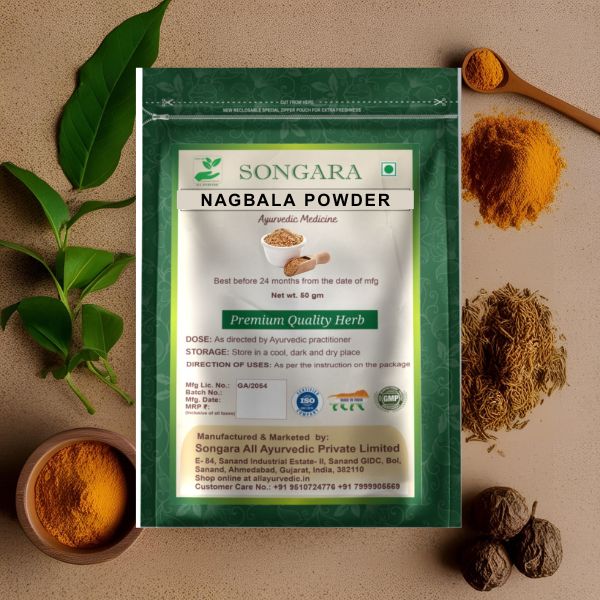
Songara All Ayurvedic
Nagbala Powder (Grewia hirsuta) – The Ayurvedic Rejuvenator
Nagbala Powder (Grewia hirsuta) – The Ayurvedic Rejuvenator
تعذر تحميل مدى توفر الطلب
🌿 Nāgabalā (नागबला)
Botanical Name: Grewia hirsuta Vahl.
Synonyms: Grewia helicterifolia Wall., Grewia polygama Mast.
Family: Tiliaceae
1. Synonyms (पर्यायनामानि)
| Sanskrit / Classical Name | Interpretation / Meaning | Remarks |
|---|---|---|
| Nāgabalā (नागबला) | “Strong like a serpent (Nāga)” | Symbolizes strength and vital energy |
| Catuṣphalā (चतुष्फला) | “Having four-parted fruit” | Refers to its quadripartite fruit structure |
| Gangerukī (गङ्गेरुकी) | Ancient synonym mentioned in classical texts | Similar to Dhanvana fruit, sometimes distinct species |
| Balātrayam (बला-त्रयम्) | Group of three Balā plants | Includes Balā, Atibalā, Mahābalā |
| Balācatuṣṭayam (बला-चतुष्टयम्) | Four Balā species | Includes Balātrayam + Nāgabalā |
| Balapañcakam (बला-पञ्चकम्) | Five Balā species | Includes Balācatuṣṭayam + Rājabalā |
| Prasārinībalā (प्रसारिणीबला) | Creeping type of Balā | Commonly associated with Grewia hirsuta |
🔹 Meaning: Nāgabalā is part of the Balā Varga group — a collection of tonic, rejuvenating, and strength-promoting herbs mentioned in Caraka Samhitā, Suśruta Samhitā, Sodhala Nighaṇṭu, and Bhāvaprakāśa Nighaṇṭu.
2. Regional Names
| Language | Common Name |
|---|---|
| Hindi | Gulasakarī, Kukurāṇḍā, Kukurabicā |
| Bihari (Local) | Setā-repadi, Setapetu, Setajaraka |
| Marathi | Govali |
| Telugu | Jibilike |
| Tamil | Tavidu |
| Kannada | Cikkuḍippe |
| Assamese | Huktapāta |
3. Botanical Description
| Feature | Description |
|---|---|
| Botanical Name | Grewia hirsuta Vahl. |
| Synonyms | Grewia helicterifolia Wall., G. polygama Mast. |
| Family | Tiliaceae |
| Habitat | Found in dry and semi-humid regions throughout India. Common in sub-Himalayan tracts and Deccan plateau. |
| Nature | Erect, small herb or under-shrub, about 1.5–3 feet high. |
| Stem | Woody, covered with fine hairs (hirsute). Branches arise near the root region. |
| Leaves | Variable in shape, oblong to obovate, serrated margin, rough and hairy on both surfaces. |
| Flowers | Yellow, small, solitary or in clusters. |
| Fruits | Distinctly quadripartite (divided into four lobes). Each lobe contains a seed; fruits are velvety. |
| Roots | Cylindrical, fibrous, brownish externally and whitish inside; used medicinally. |
4. Chemical Constituents
Scientific studies (from Grewia hirsuta and related Balā species) indicate the presence of the following compounds:
| Class | Compounds Identified |
|---|---|
| Alkaloids | Ephedrine-like alkaloids (in trace), Sterculine |
| Sterols | β-sitosterol |
| Flavonoids | Quercetin, Kaempferol derivatives |
| Triterpenoids | Lupeol, Taraxerol |
| Phenolic Compounds | Tannins, Resins |
| Sugars & Mucilage | Present in roots and stem bark |
| Fatty Acids | Palmitic acid, Stearic acid (in seed oil) |
Pharmacological activities reported:
– Anti-inflammatory
– Analgesic
– Antioxidant
– Nerve tonic
– Aphrodisiac
– Wound-healing
5. Properties and Therapeutic Uses (गुण, कर्म, उपयोग)
| Property | Description |
|---|---|
| Rasa (Taste) | Madhura (Sweet) |
| Guna (Quality) | Guru (Heavy), Snigdha (Unctuous) |
| Virya (Potency) | Śīta (Cold) |
| Vipāka (Post-digestive effect) | Madhura (Sweet) |
| Doṣa Karma | Pacifies Vāta and Pitta Doṣas |
| Prabhāva (Specific Effect) | Balya (Strength-promoting), Vṛṣya (Aphrodisiac) |
Therapeutic Actions
- Balya & Vṛṣya: Tonic for nerves and muscles; promotes vitality and strength.
- Rasāyana: Rejuvenative; improves tissue nutrition and enhances stamina.
- Śukrala: Improves sperm count and semen quality; indicated in śukra-kṣaya and male infertility.
- Vrana-ropaka: Root paste accelerates healing of wounds, boils, and abscesses.
- Vedanasthāpaka: Relieves pain and inflammation.
- Puspakripaka: Helps ripen abscesses quickly when applied topically.
- Pittahara: Reduces burning sensations and pitta disorders.
- Jvara-hara: Useful in chronic fevers associated with debility.
Clinical Indications
- Seminal debility and infertility
- Nervous weakness
- Chronic fatigue and low immunity
- Inflammatory swellings and abscesses
- Post-illness convalescence
- Vata-pitta related disorders
- Wound healing and skin infections
6. Dose (मात्रा)
Root Powder (Cūrṇa) 3–6 g With milk or honey, twice daily
7. Classical References
| Text | Mention / Reference |
|---|---|
| Caraka Saṃhitā (Madhura Skandha) | Listed under Balā Varga with Atibalā, Sahadeva, Viśvadeva, Śitapāki, Odanapāki |
| Suśruta Saṃhitā (Su. Sū. 46) | Describes Gangeruka-phala, similar in properties |
| Sodhala Nighaṇṭu | Mentions Balā-trayam properties |
| Bhāvaprakāśa Nighaṇṭu | Lists Balā-catuṣṭayam and Balā-pañcakam including Nāgabalā |
| Dhanvantari Nighaṇṭu (Redacted) | Notes Balapañcaka group as tonics and rejuvenatives |
8. Summary
🌱 Nāgabalā (Grewia hirsuta) is an important member of the Balā group of herbs known for their tonic, rejuvenative, and aphrodisiac properties.
It strengthens nerves, muscles, and reproductive organs, while externally helping in healing wounds and boils.
Its Balya (strengthening), Vṛṣya (aphrodisiac), and Rasāyana (rejuvenative) actions make it ideal for use in general debility, infertility, chronic fatigue, and post-illness recovery.
Ref: Bhavaprakash Nighantu
مواد
مواد
الشحن والاسترجاع
الشحن والاسترجاع
أبعاد
أبعاد
تعليمات العناية
تعليمات العناية
يشارك