1
/
of
5
Songara All Ayurvedic
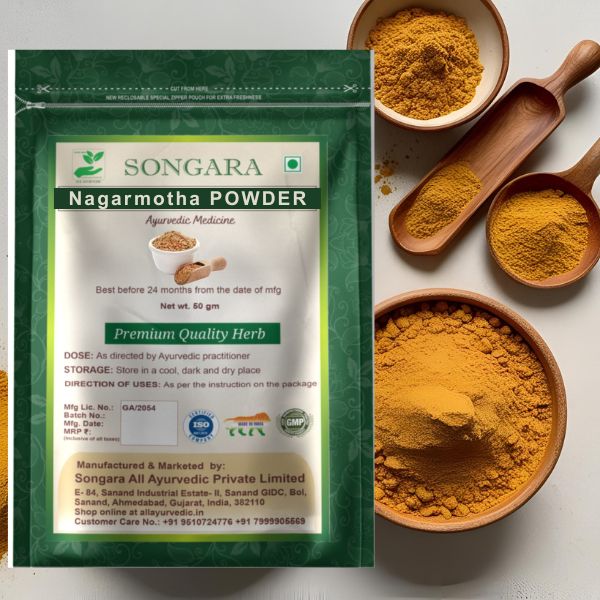
Nagarmotha Powder: Cyperus Scariosus
Nagarmotha Powder: Cyperus Scariosus
سعر عادي
Rs. 35.00
سعر عادي
Rs. 35.00
سعر البيع
Rs. 35.00
Taxes included.
يتم احتساب الشحن عند الخروج.
No reviews
Quantity
تعذر تحميل مدى توفر الطلب
🌿 Nagarmotha (Nāgaramustaka / Mustakam)
Botanical Name: Cyperus rotundus Linn.
Family: Cyperaceae
Common English Name: Nutgrass, Purple Nutsedge
1. Synonyms (पर्याय / समानार्थक नाम)
-
Sanskrit Synonyms:
मुस्तक (Mustaka), मुस्त (Musta), वारिद (Vārida), कुरुविन्द (Kuruvinda), क्रोडकसेरुक (Krodakaseruka), भद्रमुस्ता (Bhadramusta), गुन्द्रा (Gundrā), नागरमुस्तक (Nāgaramustaka) - Etymological Meanings:
- मुस्ता: “मुस्यति खण्डयति रोगान्” – That which destroys diseases.
- वारिद: “वारि ददाति” – Brings moisture, like a cloud.
- कुरुविन्द: Found in Kuru-desha (Northern India).
- क्रोडकसेरुक: Liked by pigs (Varāha-priya).
- गुन्द्रा: Grows near water reservoirs.
- नागरमुस्तक: Found near human settlements.
- भद्रमुस्ता: Promotes good health (Bhadrata).
2. Regional Names (प्रादेशिक नाम)
| Language | Name |
|---|---|
| Hindi | नागरमोथा (Nagarmotha) |
| Bengali | नागरमुथा (Nagaramutha) |
| Marathi | नागरमोथा (Nagarmotha), लवाळा (Lavalā) |
| Tamil | कोर किझंग (Kora Kizhanga) |
| Malayalam | कोर किझंग (Kora Kizhanga) |
| Telugu | तुंगगडलेवरु (Tungagadda Laveru), कोलतुंग मुस्ते (Kolatunga Muste) |
| English | Nutgrass, Purple Nutsedge |
3. Botanical Description (वनस्पतिक विवरण)
- Botanical Name: Cyperus rotundus Linn.
- Family: Cyperaceae
- Habitat: Commonly found in marshy and damp regions such as Bengal, Uttar Pradesh, and other parts of India.
- Plant Type: Slender, perennial, grass-like herb.
- Height: 16–36 inches.
- Stem: Triangular (trigonal).
- Rhizomes: Slender, aromatic, finger-like, brownish black tubers underground.
- Leaves: Narrow, grass-like, arising from the base.
- Flowers: Small, reddish-brown spikelets arranged in umbels.
4. Chemical Constituents (रासायनिक संघटक)
-
Major Active Compounds:
- Sesquiterpenes: Cyperene I & II, Cyperotundone, Cyperol, Cyperolone, α-Cyperone, β-Rotunol, α & β-Selinene, (+)-Rotundone, Mustakone, Kobusone, Isokobusone, Epoxyguaiene, Patchoulene, Humulene.
- Fatty Acids: Linoleic acid, Linolenic acid, Myristic acid, Oleic acid, Stearic acid.
- Sterols & Flavonoids: β-Sitosterol, Rhamnetin-3-O-rhamnosyl-rhamnopyranoside, Oleanolic acid-3-O-neohesperidoside.
-
Pharmacological Activities:
- Anti-inflammatory
- Anti-malarial
- Hepatoprotective
- Lipolytic (fat-reducing)
- Antimicrobial
- Antioxidant
5. Properties & Therapeutic Uses (गुण तथा औषधीय उपयोग)
Ayurvedic Properties (आयुर्वेदिक दृष्टि से):
- Rasa (Taste): Tikta (Bitter), Katu (Pungent), Kashaya (Astringent)
- Guna (Quality): Laghu (Light), Ruksha (Dry)
- Virya (Potency): Shita (Cold)
- Vipaka (Post-digestive effect): Katu (Pungent)
- Doshic Action: Pacifies Kapha, Pitta, and Rakta doshas
General Actions:
- Dipana (Appetizer)
- Pachana (Digestive)
- Lekhana (Scraping)
- Stanyashodhaka (Purifies breast milk)
- Krumighna (Anti-worm)
- Jwaraghna (Antipyretic)
- Trishnaghna (Relieves excessive thirst)
- Raktaprasadana (Purifies blood)
Therapeutic Uses (उपयोग):
- Digestive Disorders: Useful in diarrhea, dysentery, indigestion, and loss of appetite.
- Liver & Spleen: Acts as a liver protective herb; helps in jaundice and hepatomegaly.
- Fever: Effective in intermittent and malarial fevers.
- Skin Diseases: Detoxifies blood and alleviates skin irritations and itching.
- Obesity: Reduces excess fat due to its lipolytic action.
- Women's Health: Useful as a galactagogue (stimulates lactation) and purifies breast milk.
- Hair Care: Rhizomes are a common ingredient in hair oils for promoting growth and reducing dandruff.
- Wound Healing: Paste of rhizomes with ghee heals wounds and ulcers.
- Thirst & Alcoholism: Decoction relieves excessive thirst caused by heat or intoxication.
Classical References:
- Caraka Samhita: Mentioned in Lekhaniya, Kandu-ghna, Stanyashodhana mahakashayas.
- Sushruta Samhita: Listed in Vacadi and Mustadi ganas.
6. Dosage (प्रमाण / मात्रा)
| Form | Adult Dose |
|---|---|
| Churna (Powder) | 3–6 g with honey or water |
| Kwatha (Decoction) | 50–100 ml twice a day |
| Taila (Oil) | External application for hair or massage |
| Swarasa (Juice) | 10–20 ml once or twice daily |
7. Modern Research Highlights
- Anti-inflammatory: β-Sitosterol from tubers shows effect comparable to hydrocortisone.
- Anti-malarial: α-Cyperone and related sesquiterpenes active against Plasmodium falciparum.
- Hepatoprotective: Alcoholic extract protects liver against CCl₄-induced damage.
- Anti-obesity: Lipolytic effect by increasing biogenic amines that suppress appetite.
8. Safety and Storage
- Storage: Keep in cool, dry place away from moisture; tubers prone to fungal infection (Aspergillus, Curvularia, Alternaria).
- Safety: Non-toxic in traditional doses; avoid during pregnancy without medical supervision.
🌱 Summary
Nagarmotha (Cyperus rotundus) is an ancient Ayurvedic herb valued for its digestive, detoxifying, and anti-inflammatory properties. From reducing obesity and improving liver function to enhancing hair growth and balancing doshas, it remains one of Ayurveda’s most versatile herbs.
مواد
مواد
الشحن والاسترجاع
الشحن والاسترجاع
أبعاد
أبعاد
تعليمات العناية
تعليمات العناية
يشارك
No reviews