1
/
of
5
Songara All Ayurvedic
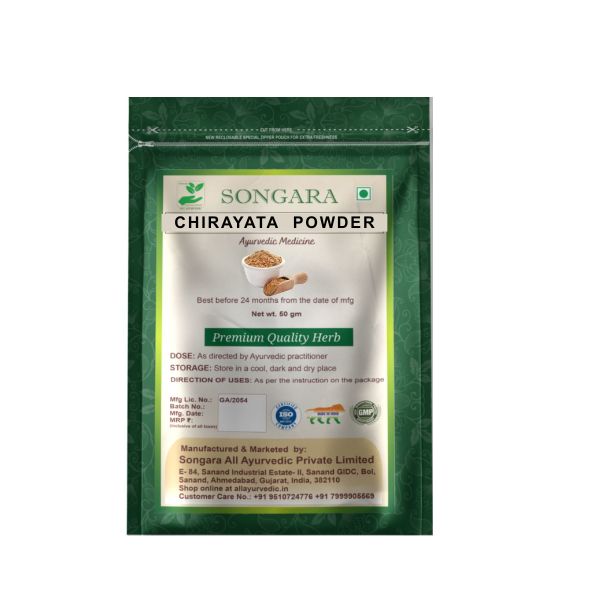
Chirayata Powder (Swertia) – The Ayurvedic Wonder Herb
Chirayata Powder (Swertia) – The Ayurvedic Wonder Herb
سعر عادي
Rs. 30.00
سعر عادي
Rs. 34.00
سعر البيع
Rs. 30.00
Taxes included.
يتم احتساب الشحن عند الخروج.
No reviews
Quantity
تعذر تحميل مدى توفر الطلب
Chirayta (Swertia chirayita Roxb. ex Flem. Karst.)
Synonyms: Kirātakaḥ, Kirātatiktaḥ, Kairātaḥ, Kaṭutiktaḥ, Kānḍatiktaḥ, Anāryatiktaḥ, Bhūnimbaḥ, Rāmasenakaḥ, Naipālaḥ, Jvarāntakaḥ.
Family: Gentianaceae
English name: Chiretta
1. Synonyms (with Etymological Derivation)
- किराततिक्तः (Kirātatiktaḥ): “किरातदेशे भवस्तिक्तः” – The bitter herb found in the region of the Kirātas.
- कैरातः (Kairātaḥ): Growing in the Kirāta region; one that removes diseases.
- कटुतिक्तः (Kaṭutiktaḥ): Denotes pungent and bitter taste.
- काण्डतिक्तः (Kānḍatiktaḥ): Its stem is bitter.
- अनार्यतिक्तः (Anāryatiktaḥ): Bitter plant from non-Aryan (Kirāta) regions.
- भूनिम्बः (Bhūnimbaḥ): “भुवि निम्ब इव” – A small herb bitter like Neem.
- रामसेनकः (Rāmasenakaḥ): Found in regions inhabited by Kirātas, who are referred to as Rāma’s army.
- नेपालः (Naipālaḥ): Found in Nepal region.
- ज्वरान्तकः (Jvarāntakaḥ): One which ends fever.
2. Regional Names
| Language | Name |
|---|---|
| Hindi | Chirayata (चिरायता), Cireta (चिरेटा), Ciraita (चिराइता) |
| Bengali | Cirata (চিরতা), Cireta |
| Marathi | Kade-chiraita (काडेचिराईत), Chiraita |
| Gujarati | Kariyatu (करियातु) |
| Kannada | Nelabendu (नेलबेंडु) |
| Telugu | Nilavemu (नीलवेमु) |
| Tamil | Nilavembu (नीलवेम्बु) |
| Malayalam | Nilaveppa (नीलवेप्प) |
| English | Chiretta |
3. Botanical Description
- Botanical name: Swertia chirayita (Roxb. ex Flem.) Karst.
- Synonym: Swertia chirata Buch.-Ham. ex C.B. Clarke
- Family: Gentianaceae
Description:
An erect, annual herb reaching 60–125 cm in height, found abundantly in the Himalayan regions, especially Nepal (altitude 1200–1300 m).
- Stem: Robust, cylindrical at the base, quadrangular above.
- Leaves: Opposite, ovate to broadly lanceolate, cordate at base.
- Flowers: Small, greenish-yellow, in terminal and axillary panicles.
- Fruit: Minute, pointed capsules containing numerous smooth, many-angled seeds.
- Part Used: Entire plant (whole herb).
4. Chemical Constituents
Chirayata contains a wide range of bitter principles, alkaloids, xanthones, flavonoids, and terpenoids:
- Bitter principles: Amarogentin, Gentiopicrin.
- Xanthones: Chiratol, Swerchirin, Swertianin, Swertinin, Mangiferin, Chiratanin.
- Flavonoids: Enicoflavine, Gentianine, Gentiocrucine.
- Fatty acids: Cerolic, Oleic, Ophelic, Palmitic, Stearic acids.
- Amino acids: Arginine, Aspartic acid, Glutamic acid, Leucine, Methionine, Threonine, Tryptophan.
- Triterpenoids: β-amyrin, Lupeol, Oleanolic acid, Ursolic acid, Taraxerol, Friedelin.
- Sterols: β-sitosterol.
- Other compounds: Chiratenol, Swerta-7,9(11)-dienol, Swertenol, Epichiratenol, Pichierenol.
- Adulterants: Swertia angustifolia (inferior quality) and Rubia cordifolia roots (distinguished by purple color).
5. Properties and Therapeutic Uses
Ayurvedic Properties (Rasa–Guna–Virya–Vipaka):
- Rasa (Taste): Tikta (Bitter)
- Guna (Quality): Laghu (Light), Rūkṣa (Dry)
- Virya (Potency): Śīta (Cold)
- Vipāka: Katu (Pungent)
- Doshic Action: Pacifies Pitta, Kapha and Rakta doshas; mildly aggravates Vata.
Therapeutic Uses:
- Excellent bitter tonic and febrifuge.
- Used in Sannipata jvara, malarial fever, chronic fever, burning sensation, hyperacidity, flatulence, loss of appetite, liver disorders, jaundice, and anaemia.
- Beneficial in skin diseases, worms, dropsy, vomiting, and indigestion.
- Has cholagogue and stomachic actions—stimulates bile and improves digestion.
- Used externally in certain skin eruptions (Ajagallika) with borax.
- Increases appetite and relieves constipation without causing bowel obstruction (unlike other bitters).
- Acts as a blood purifier and anti-inflammatory.
Classical references:
- Mentioned in Caraka Saṃhitā (Su. Ch. 4) under Stanyasodhana & Tṛṣṇānigrahana Mahākāśāya.
- In Suśruta Saṃhitā (Su. 38) under Āragvadhādi gaṇa.
Formulations:
- Sudarśana cūrṇa – for fevers and digestion.
- Bhūnimba cūrṇa – for diarrhoea and worms.
- Kiratādi taila – used externally for emaciation and anaemia.
6. Dose and Administration
Powder (Cūrṇa)
500 mg – 1.5 g
With honey or lukewarm water
| Form | Adjuvant / Anupana | |
|---|---|---|
| Powder (Cūrṇa) | 500 mg – 1.5 g | With honey or lukewarm water |
| Decoction (Kaṣāya) | 10–20 ml | Twice daily after meals |
| Infusion | 15–30 ml | With clove, cinnamon, or aromatic herbs for digestion |
| External use | — | Applied in skin diseases with borax |
Summary of Key Actions
| Property | Effect |
|---|---|
| Bitter tonic | Improves digestion and appetite |
| Febrifuge | Reduces fever and inflammation |
| Hepatoprotective | Protects and strengthens liver |
| Anthelmintic | Kills intestinal worms |
| Antimicrobial | Fights infections |
| Anti-inflammatory | Reduces pain and swelling |
| Blood purifier | Improves complexion and removes toxins |
Note:
Chirayata should be used in moderate doses under medical supervision, especially in individuals with high Vata dosha or excessive body dryness.
Ref: Bhavaprakash Nighantu
مواد
مواد
الشحن والاسترجاع
الشحن والاسترجاع
أبعاد
أبعاد
تعليمات العناية
تعليمات العناية
يشارك
No reviews