songara all ayurvedic
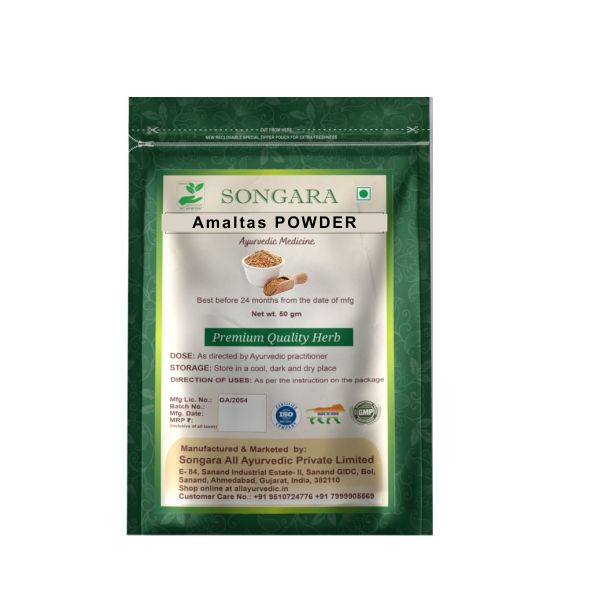
Amaltas Powder (Cassia Fistula) – The Ayurvedic Detox & Healing Herb
Amaltas Powder (Cassia Fistula) – The Ayurvedic Detox & Healing Herb
تعذر تحميل مدى توفر الطلب
🌿 AMALTAS (Cassia fistula Linn.)
1. Synonyms (नाम एवं पर्याय)
Sanskrit Names:
आरग्वध (Aragvadha), राजवृक्ष (Rajavriksha), शम्पाक (Shampaka), चतुरङ्गुल (Chaturangula), आरेवतः (Arevata), व्याधिघात (Vyadhighata), कृतमाल (Kritamala), सुवर्णक (Suvarnaka), कर्णिकार (Karnikara), दीर्घफल (Dirghaphala), स्वर्णाङ्ग (Swarnanga), स्वर्णभूषण (Swarnabhushana)।
Etymological Meaning:
- आरग्वध: One which destroys (वध) diseases (आरग).
- राजवृक्ष: “King of trees” due to its golden flowers.
- सुवर्णक / स्वर्णाङ्ग: Having golden-yellow blossoms like gold.
- दीर्घफल: Having long cylindrical fruits.
English Synonyms:
Indian Laburnum, Purging Cassia, Golden Shower Tree.
2. Regional Names (प्रादेशिक नाम)
| Language | Regional Name |
|---|---|
| Hindi | अमलतास (Amaltas), सोनहाली (Sonahali) |
| Bengali | सोनालु (Sonalu), बन्दरलाठी (Bandarlathi) |
| Marathi | बहावा (Bahawa) |
| Kannada | कक्केमारा (Kakkemara) |
| Telugu | रेळचेत्तु (Relachettu) |
| Tamil | कोन्नेमरम (Konnemaram), सरकोन्ने (Sarakonne) |
| Malayalam | कोन्ना (Konna) |
| Gujarati | गरमाळो (Garamālo) |
| Oriya | सुनारी (Sunari) |
| Punjabi | अमलतास (Amaltas), करंगला (Karangala) |
Botanical Name: Cassia fistula Linn.
Family: Leguminosae / Fabaceae
3. Botanical Description (वनस्पति विवरण)
Amaltas is a moderate-sized deciduous tree common throughout India, especially in sub-Himalayan tracts, Chhota Nagpur, Central India, and up to Maharashtra.
- Height: 10–15 meters.
- Bark: Greenish-grey or brick-red, smooth.
- Leaves: Paripinnate, 5–12 cm long, with 8–16 leaflets that are ovate-lanceolate and acuminate.
- Flowers: Bright yellow, in long, hanging racemes, blooming in summer (March–May).
- Fruits: Cylindrical, pendulous, indehiscent pods (25–30 cm long), containing numerous small, flat seeds embedded in dark, sweet pulp.
- Seeds: Smooth, flat, surrounded by blackish pulp.
Flowering Season: March–May
Fruiting Season: May–December
4. Chemical Constituents (रासायनिक संघटक)
Pods:
Contain fistulic acid (1,4-dihydroxy-6,7-dimethoxy-2-methyl-anthraquinone-3-carboxylic acid), rhein, and anthraquinone derivatives.
Flowers:
Contain kaempferol, rhein, fistulin, leucopelargonidin tetramer, cetyl alcohol, and dianthraquinone glucoside.
Bark and Heartwood:
Contain barbaloin, fistucacidin, leucoanthocyanidin, 3,4,7,8,4’-pentahydroxyflavan, and rhein.
Leaves:
Contain senno- sides A and B (laxative anthraquinone glycosides), rhein glucoside, and procyanidins.
Stem bark:
Contains β-sitosterol, lupeol, hexacosanol, tannins.
Other compounds reported:
- Emodin, chrysophanic acid, epicatechin, phlobaphene, biflavonoids, triflavonoids, clitorin, proanthocyanidins.
5. Properties and Therapeutic Uses (गुण एवं औषधीय उपयोग)
Ayurvedic Properties (गुण धर्म):
- Rasa (Taste): Madhura (Sweet)
- Guna (Quality): Guru (Heavy)
- Virya (Potency): Shita (Cold)
- Vipaka (Post-digestive): Madhura
- Karma (Action): Sāraka (Excellent laxative), Pittahara, Vatahara, Raktashodhaka.
Therapeutic Actions (औषधीय क्रियाएं):
- Best among Virechana Dravyas (purgative herbs).
- Laxative: Soft, non-irritant; ideal for children, elderly, and weak patients.
- Antipyretic: Effective in fevers (including malaria, anthrax).
- Blood purifier: Useful in skin disorders like Kustha (leprosy), Pama, Dadru, Kandu.
- Anthelmintic and Antimicrobial: Pod and bark extracts show antiviral and antibacterial activity.
- Anti-inflammatory: Root and bark extract reduce inflammation.
- Cardio-protective: Root bark beneficial in cardiac ailments.
- Hepato-protective: Leaves used in jaundice.
- Dermatological use: Leaf juice applied in eczema, ringworm, pruritus, and eruptions.
Classical References (आयुर्वेद ग्रंथों में उल्लेख):
- Charaka Samhita: Mentioned in Virechana Varga and Kusthaghna Mahakashaya.
- Sushruta Samhita: Part of Aragvadhadi gana and Adhobhagahara gana.
- Vagbhata: Recommended for purgation and skin diseases.
Therapeutic Uses by Plant Part:
| Part | Uses |
|---|---|
| Pulp (फलं) | Laxative, febrifuge, used in constipation, fever, gout, and rheumatism; externally in arthritis & abscess. |
| Seeds (बीज) | Emetic in large dose; anti-amoebic; used in Raktapradara (menorrhagia). |
| Leaves (पत्ते) | Used in jaundice, piles, rheumatism; externally in skin disorders. |
| Root & Bark (मूल एवं छाल) | Astringent, tonic, febrifugal, purgative; used in cardiac and skin diseases. |
| Flowers (पुष्प) | Astringent, purgative, antibilious; also used as food. |
6. Dose (मात्रा)
Pulp (from pod) 4–8 grams
Seed powder 5–7 seeds (as emetic)
7. Summary of Actions
- Primary: Mild laxative, detoxifier, and blood purifier.
- Secondary: Antipyretic, anti-inflammatory, antimicrobial, and hepatoprotective.
- Ideal for: Chronic constipation, fevers, skin diseases, jaundice, gout, and rheumatism. Ref: Bhavaprakash Nighantu
مواد
مواد
الشحن والاسترجاع
الشحن والاسترجاع
أبعاد
أبعاد
تعليمات العناية
تعليمات العناية
يشارك