Songara All Ayurvedic
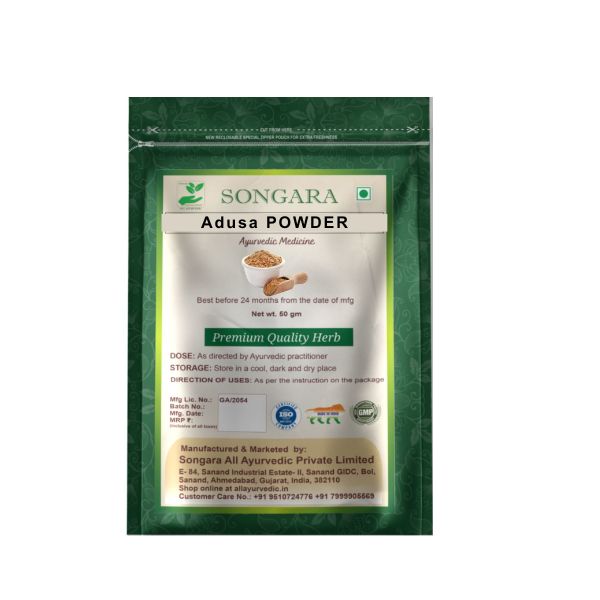
Adusa Powder (Adhatoda Vasica) – The Ayurvedic Respiratory Healer
Adusa Powder (Adhatoda Vasica) – The Ayurvedic Respiratory Healer
تعذر تحميل مدى توفر الطلب
🌿 Adusa / Vasa (Justicia adhatoda Linn.)
Family: Acanthaceae
Sanskrit Name: वासा (Vāsā)
English Name: Malabar Nut / Vasaka
🔹 1. Synonyms (पर्याय नाम)
- वासक (Vāsaka): “वाति गच्छति श्लेष्मा अनया वासा” — It expels phlegm (Kapha) from the body.
- वासिका (Vāsikā): Always desired (vāśyate) by physicians for curing Shvāsa and Kāsa.
- भिषङ्माता (Bhiṣaṅmātā): “Mother of physicians,” as it is beneficial in numerous diseases and acts compassionately like a mother.
- सिंहिका / सिंहमुख / सिंहास्य (Simhikā / Simhamukha / Simhāsya): The flowers resemble the open mouth of a lion.
- वाजिदन्ता (Vājidantā): The white petals resemble the teeth of a horse.
- आटरूष / अटरूषक (Āṭarūṣa / Aṭarūṣaka): Destroys diseases by spreading energy or movement (ruṣati rogān).
- वृष (Vṛṣa): Contains sweet juice at its flower base.
- सिंहपर्ण (Simhaparṇa): Leaves resemble the ear lobes of a lion.
🔹 2. Regional Names
| Language | Name |
|---|---|
| Hindi | Adusa, Bakas, Basuti |
| Bengali | Basak |
| Marathi | Adulsa |
| Gujarati | Aradusi |
| Kannada | Adusoge |
| Telugu | Addasaramu |
| Tamil | Adathodai |
| Punjabi | Bansa |
| English | Malabar Nut, Vasaka |
🔹 3. Botanical Description
Botanical Name: Justicia adhatoda Linn.
Family: Acanthaceae
- Habitat: Found throughout India, especially in tropical and sub-tropical regions; grows well on wastelands and roadsides.
- Type: Large evergreen shrub, 1.5–2.5 meters tall.
- Leaves: Opposite, large, lanceolate, and leathery with prominent veins; emit a characteristic strong odour.
- Flowers: White with purple streaks, arranged in dense terminal spikes; resemble a lion’s mouth.
- Fruit: Capsule-shaped, clavate, containing small yellowish-brown seeds.
- Root and Bark: Light brown, fibrous.
🔹 4. Chemical Constituents
The plant contains a rich variety of alkaloids, flavonoids, and essential oils.
Major Active Compounds:
- Alkaloids: Vasicine (Peganine), Vasicinone, Vasicinol, Vasicinolone, Deoxyvasicinone, Vasicol, Anisotine, Adhatodine, Vasicoline, Vasicolinone, Adhavasinone
- Flavonoids: Kaempferol, Luteolin, Quercetin, Kaempferol 3β-D-glucoside, 5-sophoroside
- Sterols: β-Sitosterol, α-Amyrin
- Other Constituents: Adhatodic acid, Vasakin (a non-nitrogenous principle), Carotene, Galactose derivatives, Triterpenes, Essential oil, Ascorbic acid (Vitamin C), Long-chain fatty acids (arachidic, behenic, linoleic, oleic, lignoceric, cerotic)
Pharmacological Observations:
- Vasicine exhibits bronchodilatory, respiratory stimulant, uterotonic, and abortifacient activities.
- Vasicinone acts as an anti-anaphylactic agent and balances the effects of vasicine in combination.
- Alcoholic extracts show antibacterial, antifungal, and antitubercular properties.
- Essential oils have expectorant and rubefacient action.
- Resinous extract shows mild insecticidal and weedicidal activity.
🔹 5. Properties and Therapeutic Uses (गुण एवं औषधीय उपयोग)
Rasa (Taste): Tikta (bitter), Kaṣāya (astringent)
Guna (Qualities): Laghu (light), Rukṣa (dry)
Virya (Potency): Śīta (cold)
Vipāka (Post-digestive effect): Kaṭu
Doshaghna: Pacifies Kapha and Pitta, but aggravates Vāta.
Pharmacological Actions:
- Shvāsahara: Relieves asthma and breathlessness
- Kāsahara: Cures cough and promotes expectoration
- Raktapittahara: Stops internal bleeding and haemoptysis
- Jvaraghna: Reduces fever
- Kusthaghna: Cures skin diseases
- Krumighna: Destroys intestinal worms
- Hridya: Beneficial to the heart
- Stanyashodhana: Purifies breast milk
- Pittaghna: Cools excess heat and reduces inflammation
- Kaphaghna: Expels mucus from respiratory channels
Therapeutic Uses:
- Respiratory Disorders:
- Used in Shvāsa (asthma), Kāsa (cough), Bronchitis, Tuberculosis, Fever associated with chest congestion.
- Vasa swarasa (fresh leaf juice) mixed with ginger juice, black pepper, and honey relieves cough and breathlessness.
- Decoction of Vasa, Drākṣā, Harītakī with honey is useful in chronic cough.
- In Balakāsa (children’s cough), leaf juice is given with Tankana (borax).
- Bleeding Disorders (Raktapitta, Epistaxis, Haemoptysis):
- Leaf juice with honey stops bleeding.
- Vāsāghṛta (ghee processed with Vasa) is beneficial in Raktapitta and Kṣaya (tuberculosis).
- Digestive Disorders:
- Leaf juice relieves diarrhoea and dysentery due to its antibacterial property.
- Arthritis and Inflammation:
- Poultice of leaves applied on joints reduces Śotha (swelling) and Śūla (pain).
- External Uses:
- Leaves act as insect repellents and mild fungicides.
- Infusion of leaves used against white ants and red spider mites.
- Useful in storing fruits and water to prevent bacterial contamination.
- Gynaecological Use:
- Vasicine acts as a uterotonic and can be used under supervision in cases of postpartum haemorrhage.
- Miscellaneous:
- Leaves are smoked as cigarettes for immediate relief in bronchial asthma.
- Flowers improve blood circulation and act as mild tonics.
🔹 6. Doses (मात्रा)
- Powder of Leaves: 1–2 grams
⚕️ Summary
Vasa (Adusa) is one of Ayurveda’s foremost herbs for respiratory and bleeding disorders. Rich in the alkaloid vasicine, it acts as a bronchodilator, expectorant, haemostatic, and anti-tubercular agent. It liquefies mucus, relieves breathlessness, and purifies blood. The plant also possesses antibacterial, anti-inflammatory, uterotonic, and insecticidal properties.
Key Benefits:
- Clears respiratory passages and eases breathing
- Stops internal bleeding (Raktapitta)
- Reduces inflammation and fever
- Detoxifies the body by pacifying Kapha and Pitta
- Promotes voice clarity and lung health
Ref: Bhavaprakash Nighantu
مواد
مواد
الشحن والاسترجاع
الشحن والاسترجاع
أبعاد
أبعاد
تعليمات العناية
تعليمات العناية
يشارك